

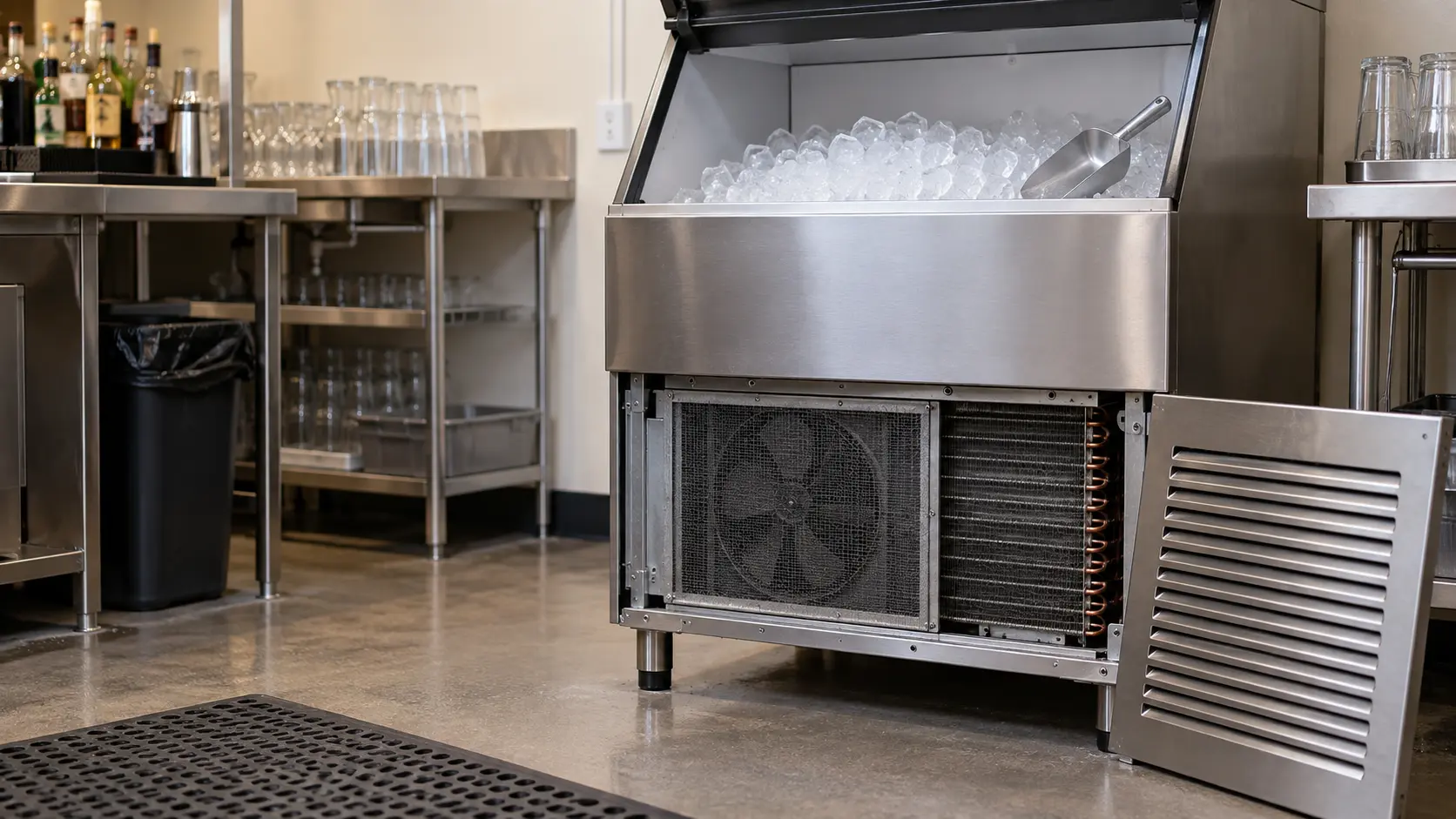
What the condenser does and why its type follows you
Freezing water means pulling heat out of it, and the ice machine has to put that heat somewhere. The condenser is the coil where it leaves the cooling system. On an air-cooled machine a fan pushes room air through the coil; on a water-cooled machine the coil sits in a jacket of flowing water; on a remote model the coil and its fan are mounted outdoors and connected to the head by insulated tubing.
The choice is usually made once, when the machine is bought, but it follows the owner for the life of the machine. It decides the plumbing behind the unit, how warm the room gets, and which maintenance jobs come up every few months.
Air-cooled: the simplest to install, the fussiest about the room
Air-cooled machines come in every format, from undercounter units to large modular heads. They need only a water line, a drain and power, and they are the only kind the ENERGY STAR program certifies. The price of that simplicity is that the room becomes part of the cooling system: every bit of heat taken from the ice comes back out of the vents.
- Good fit: a bar back, an office pantry or a hotel floor alcove with steady room temperature and space at the vents.
- Poor fit: a closet with a closed door, a hot cook line or a spot beside an oven or a dish machine exhaust.
- Watch for: warm air building up behind the unit, and a filter that goes gray within weeks.
Room temperature and open space
The limits differ by maker: Manitowoc's Indigo NXT heads are rated to run in air between 35°F and 110°F, while Scotsman sets 50°F as the floor and 100°F as the ceiling for its E series cube machines. Scotsman warns that an air-cooled machine still runs with tight clearance at the sides, back and top, but makes significantly less ice. The Department of Energy adds that each maker puts the air intake and exhaust in a different place, so staff need to know which panels must never be blocked.
The filter in front of the coil
Self-contained air-cooled machines carry a washable filter over the condenser intake. Manitowoc puts it on a monthly wash in a mild soapy solution, and our guide to keeping the condenser clean walks through the job. A kitchen with grease in the air fills that filter faster than any other setting.
Source: U.S. Department of Energy, FEMP — Purchasing Energy-Efficient Air-Cooled Ice Machines — Remote condensers sit outdoors or in unconditioned rooms and keep the heat out of the conditioned space; air intake and exhaust locations differ by maker and must not be blocked; ENERGY STAR excludes water-cooled machines and dispensers

Water-cooled: quiet and steady, if the water is handled well
A water-cooled machine makes little heat or fan noise in the room, which suits tight, hot spaces. It needs a second water connection to the condenser and a drain for the warm water that leaves it. Manitowoc's limits for its current heads show what the plumbing must deliver: water entering the condenser no warmer than 90°F, leaving no warmer than 110°F, and pressure at the condenser no higher than 276 psig.
Single-pass water against a cooling tower
The Department of Energy's buyer guidance says water-cooled ice machines should be used only where they can connect to a cooling tower that runs all year. It advises against single-pass cooling, where drinking water runs through the condenser once and then down the drain, and recommends an ENERGY STAR air-cooled machine wherever a year-round tower is not available. Some local codes restrict single-pass cooling as well, so check before choosing it.
The valve that meters condenser water
A regulating valve opens as the pressure in the cooling system rises and closes as it falls. The same federal guidance points out that when this kind of valve sticks open, water keeps flowing through the condenser whether the machine is running or not. Water running to the drain with the machine off, or a water bill that jumps, is worth a visit.
Source: Manitowoc — Indigo NXT Ice Machines Installation, Operation and Maintenance Manual — Head air temperature 35–110°F; remote condensers −20 to 120°F; condenser water in ≤90°F, out ≤110°F, ≤276 psig; clean the air filter monthly with mild soap and water; some models contain up to 500 grams of flammable R290
Remote: the heat goes outside, the work goes up a ladder
A remote model keeps the ice-making head indoors and puts the condenser and its fan outside or in an unconditioned equipment room. The Department of Energy notes the advantage directly: the heat of making ice leaves the building instead of loading the air conditioning. It is common for large heads in busy restaurants, hotels and arenas.
The outdoor coil works through weather. Manitowoc rates its remote condensers from minus 20°F to 120°F, and Scotsman's flake and nugget manual asks for the remote coil to be checked for leaves, grease and dirt every time the machine is cleaned. The line set between head and condenser holds refrigerant under pressure, and its length and rise are set by the maker's limits at installation.
- A place outdoors or in an unconditioned room for the condenser, with space around it for air and cleaning.
- A mounting base that meets local building codes.
- Power run to the condenser fan.
- A refrigerant line set within the maker's length and rise limits.
What changes with newer remote systems
Many new self-contained machines now run on R-290, a flammable refrigerant, in small charges; Manitowoc's current manual allows up to 500 grams in some models. Remote systems carry refrigerant along the whole line set, and federal rules treat them as a separate category from self-contained machines. Either way, the line set and the outdoor coil are technician territory.
Source: U.S. Department of Energy, FEMP — Purchasing Energy-Efficient Air-Cooled Ice Machines — Remote condensers sit outdoors or in unconditioned rooms and keep the heat out of the conditioned space; air intake and exhaust locations differ by maker and must not be blocked; ENERGY STAR excludes water-cooled machines and dispensers; Manitowoc — Indigo NXT Ice Machines Installation, Operation and Maintenance Manual — Head air temperature 35–110°F; remote condensers −20 to 120°F; condenser water in ≤90°F, out ≤110°F, ≤276 psig; clean the air filter monthly with mild soap and water; some models contain up to 500 grams of flammable R290; Scotsman — Installation and User's Manual, Modular Flake and Nugget Ice Machines, Prodigy Plus A Series — Check the remote condenser coil for leaves, grease and dirt every time the machine is cleaned; Scotsman — Installation and User's Manual, Modular Flake and Nugget Ice Machines, Prodigy Plus A Series (remote condenser installation) — Remote condenser located with space for air and cleaning, attached to the roof per local building codes, powered separately, with line set length and rise limits
Choosing between the three for your space
The deciding questions are about the building rather than the ice. The table gives the short version; a site visit settles the details, such as where a drain can run and whether a roof has room for a condenser.
| Air-cooled | Water-cooled | Remote | |
|---|---|---|---|
| Where the heat goes | Into the room | Into condenser water | Outdoors |
| Extra connections | None | Condenser water in and out | Line set and outdoor power |
| Room it suits | Ventilated, moderate temperature | Hot or cramped, with a tower loop | Busy spaces with roof or yard access |
| Regular upkeep | Filter and coil cleaning | Water treatment, valve checks | Outdoor coil cleaning |


