

Modular Ice Machine Repair
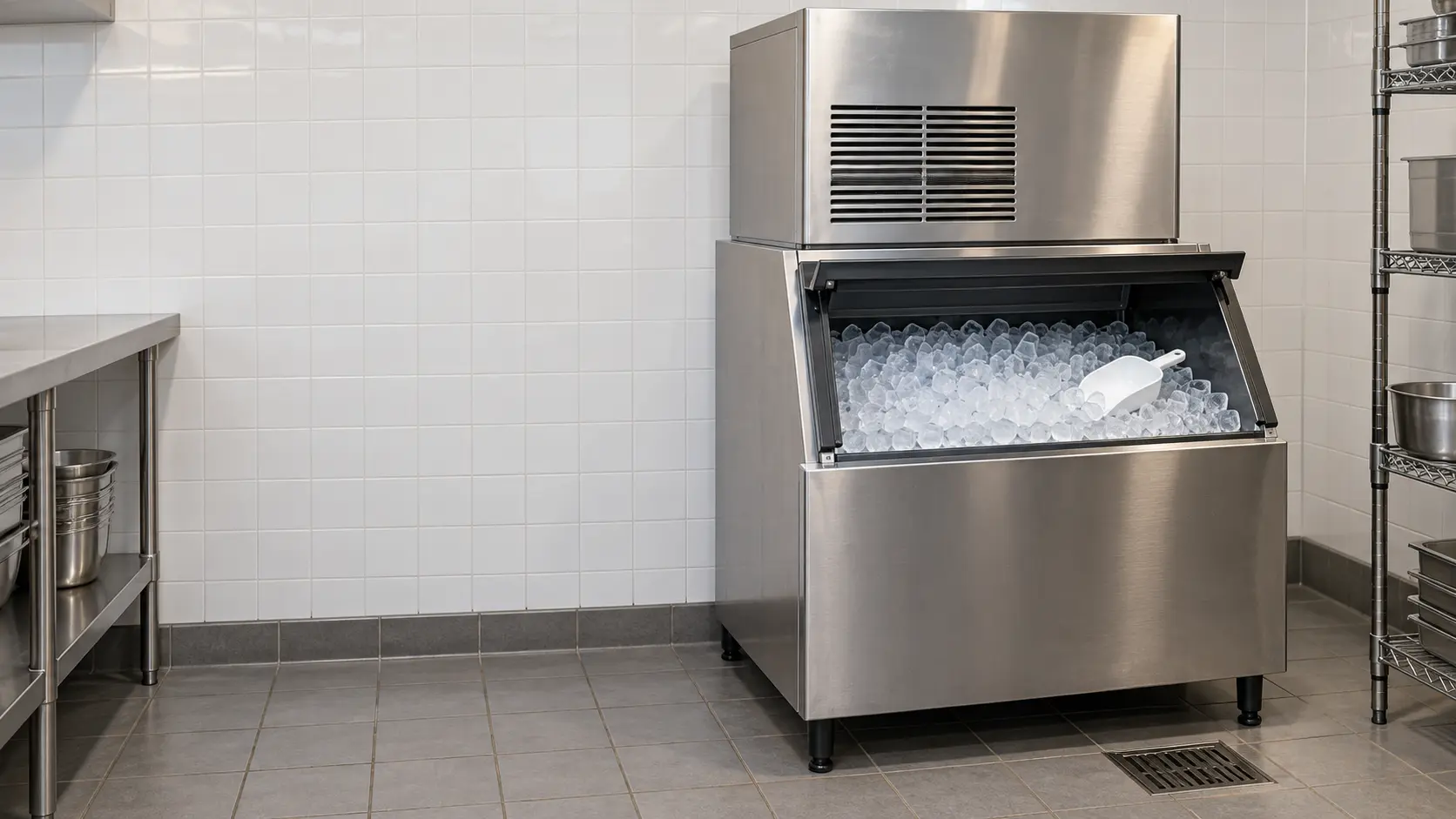
An ice-making head set on top of a separate storage bin or drink dispenser, cooled by air, water or a condenser on the roof, turning out hundreds of pounds of cubes a day.
Mon–Sat, 8am–8pm
- 4 things that fail on it
- 10 makes build it
- 6 problems it shows
Book a visit
Three short steps, about a minute.
or call (844) 410-9163
Loading appointment form…
The appointment form couldn’t load. Please try again.
Is yours
a modular?
A modular ice machine is two pieces of equipment stacked into one: an ice-making head, commonly 22, 30 or 48 inches wide, and the insulated bin or beverage dispenser it sits on. The head holds everything that makes ice. Water from the supply line passes a filter and an inlet valve into a sump, a small pump lifts it to a distribution tube that spreads it evenly over a vertical evaporator plate, and a hinged water curtain in front keeps the spray where it belongs. When the thickness probe feels the sheet of cubes reach full size, a hot gas valve warms the plate and the slab slides off into the bin, on many heads helped by a harvest assist motor or pin. Heat leaves through an air-cooled condenser and its fan, a water-cooled condenser governed by a regulating valve, or a remote condenser on the roof joined to the head by long line sets. A bin control, whether a thermostat bulb, a paddle or an electronic eye, stops production once the bin is full, and whatever melts runs out through a gravity drain and an air gap to the floor drain.
 What fails on a modular ice machine
How to tell
The part that makes ice is a separate box sitting on top of the bin or dispenser, with its own front panel above the bin door.
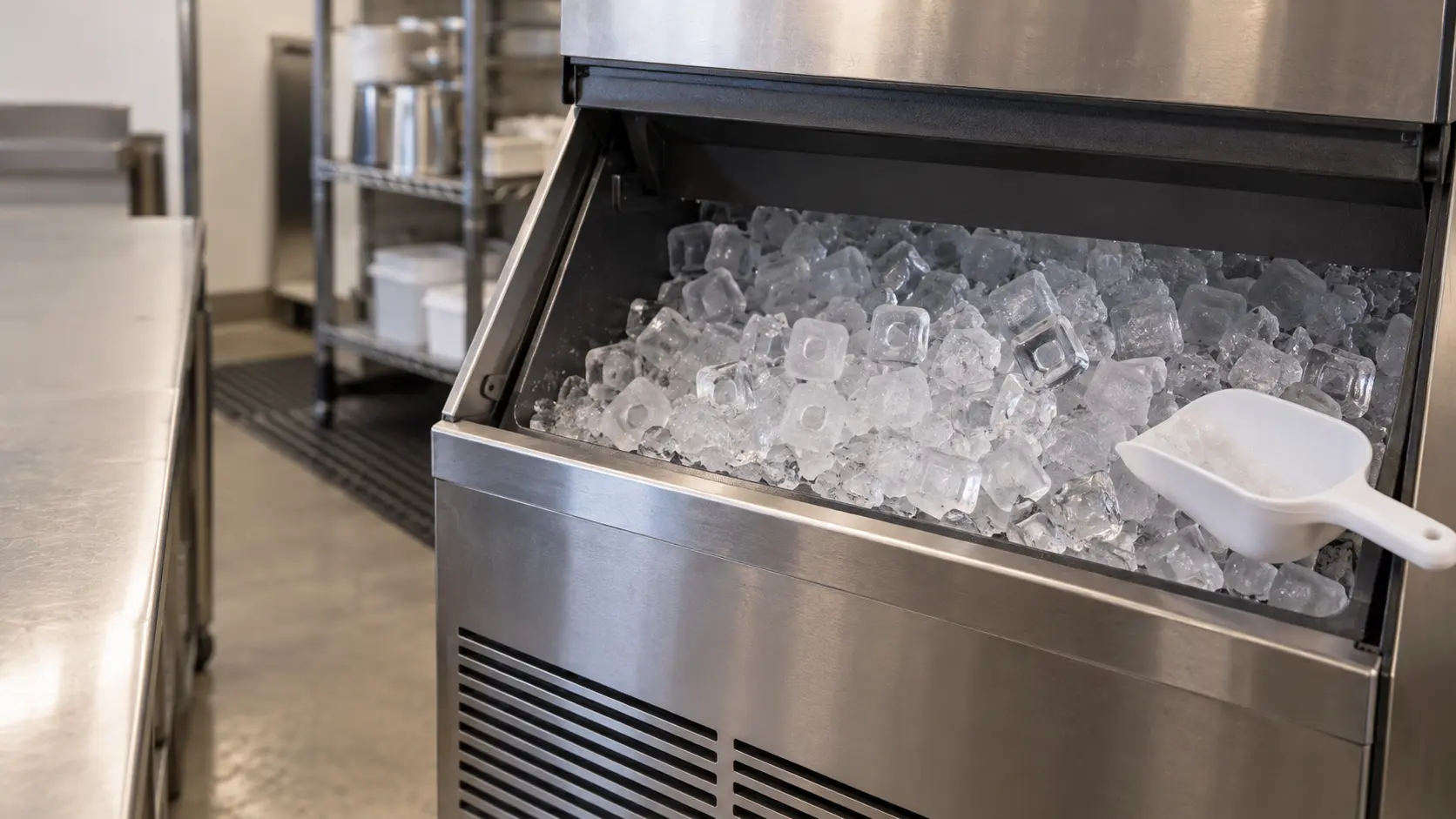
Lifting the bin door shows a deep insulated well with a scoop, and above it the opening where cubes fall from the head.
The data plate lists a daily output in the hundreds of pounds, and the ice machine stands near a floor drain on a circuit of its own.
If the head is fairly quiet but copper lines rise from it into the ceiling, the condenser is remote, usually on the roof.
Not yours?Undercounter ice machineNugget ice machineIce and water dispenser
What fails
on this design.
On a modular ice machine: scale on the evaporator and the distribution tube, hot gas valve and harvest assist, condenser, fan motor and water regulating valve, inlet valve, sump level and water pump.
The problems it showsScale on the evaporator and the distribution tube
Minerals left behind by the water coat the plate and plug the small holes of the distribution tube. Cubes grow unevenly, stay hollow on one side, or fuse into a slab that will not release, and production drops well before the machine stops altogether.
Hot gas valve and harvest assist
The valve that sends warm gas through the plate can stick open, so the head never builds a full sheet, or stay shut, so the sheet never lets go. Where a harvest assist motor or pin is fitted, a worn one leaves the slab hanging until the cycle times out.
Condenser, fan motor and water regulating valve
An air-cooled coil packed with grease and lint, or a fan motor that has stopped, lets pressure climb until the head shuts itself off on a hot afternoon. A water-cooled head wastes water when its regulating valve sticks open, and trips on high pressure when it sticks shut.
Inlet valve, sump level and water pump
The inlet valve can dribble into the sump all day or refuse to open, and the pump feeding the distribution tube wears out its bearings. Either one shows up as thin, cloudy or missing ice while the compressor keeps running.
Getting at it,
and whether to.
The head sits at shoulder height or above, on top of its bin, so please clear the floor in front of the ice machine and anything stored on top of it before the visit.
What repairs costOn the visit
- The panels over the wiring and the sealed system come off only with the machine switched off at its disconnect, and that is the technician's work; many current heads run on R-290, a flammable refrigerant, and are serviced with the care it calls for.
- If the machine has stopped making ice, leave the bin as it is, so the technician can see how much it held and whether the melt is draining away.
- A remote-cooled machine has its condenser on the roof or an outside wall: tell us where and how to reach it, since a ladder or roof access becomes part of the visit.
Repair or replace
A modular head is usually worth repairing. The bin or dispenser, the water line, the drain and the electrical circuit are already built around it, and valves, pumps, probes, fan motors and a thorough cleaning cost a fraction of a new head. A compressor or an evaporator is a larger decision: on a head well into its second decade, one charged with an older gas that is no longer made, or one whose evaporator plating has worn through, the technician puts the repair beside a new head of the same footprint and leaves the choice with you.
Book a visit for a modular ice machineThe problems
it shows.
On a modular ice machine, most often ice machine running but not making ice.
All problems
Ice Machine Running but Not Making Ice
6 causes, cheapest first

Ice Machine Making Too Little Ice for the Rush
6 causes, cheapest first

Ice Machine Not Harvesting: Ice Stays Stuck on the Plate
6 causes, cheapest first
Ice Machine Cubes Coming Out Thin, Small or Hollow
6 causes, cheapest first

Ice Machine Water Running Nonstop to the Drain
6 causes, cheapest first
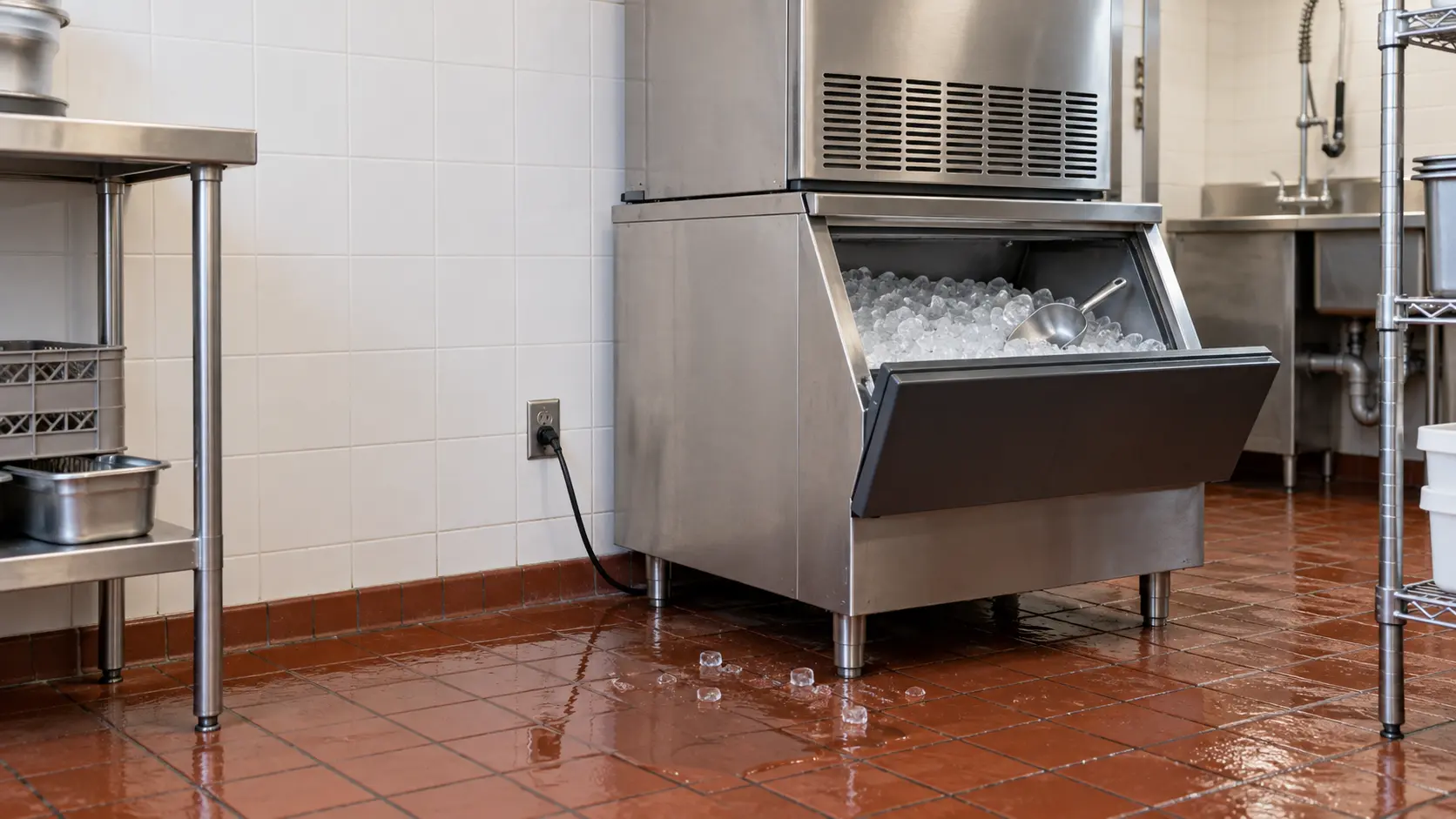
Ice Machine Leaking Water Across the Floor or Under the Bin
6 causes, cheapest first
Who builds
a modular.
10 of the makes on this site build a modular ice machine. Each mark opens that make's own page.
All 20 brandsModular ice machine repair,
where we come out.
9 metros, each with its own page.
All service areasTampa BayFL · 31 areas
Miami / South FloridaFL · 47 areas
New York MetroNY · 75 areas
HoustonTX · 36 areas
ChicagoIL · 50 areas
Los AngelesCA · 95 areas
San DiegoCA · 31 areas

Questions about
modular ice machines.
How often does a modular ice machine need cleaning and sanitizing?
Why does my modular ice machine run all day but the bin never fills?
Can a head be moved onto a different bin or dispenser?
Does a remote-cooled ice machine need someone on the roof?
Back to your everyday
Is it a modular ice machine?
Say so when you book — it changes what the technician brings and how the visit is planned.