

Two ways to freeze water, and the ice each one gives
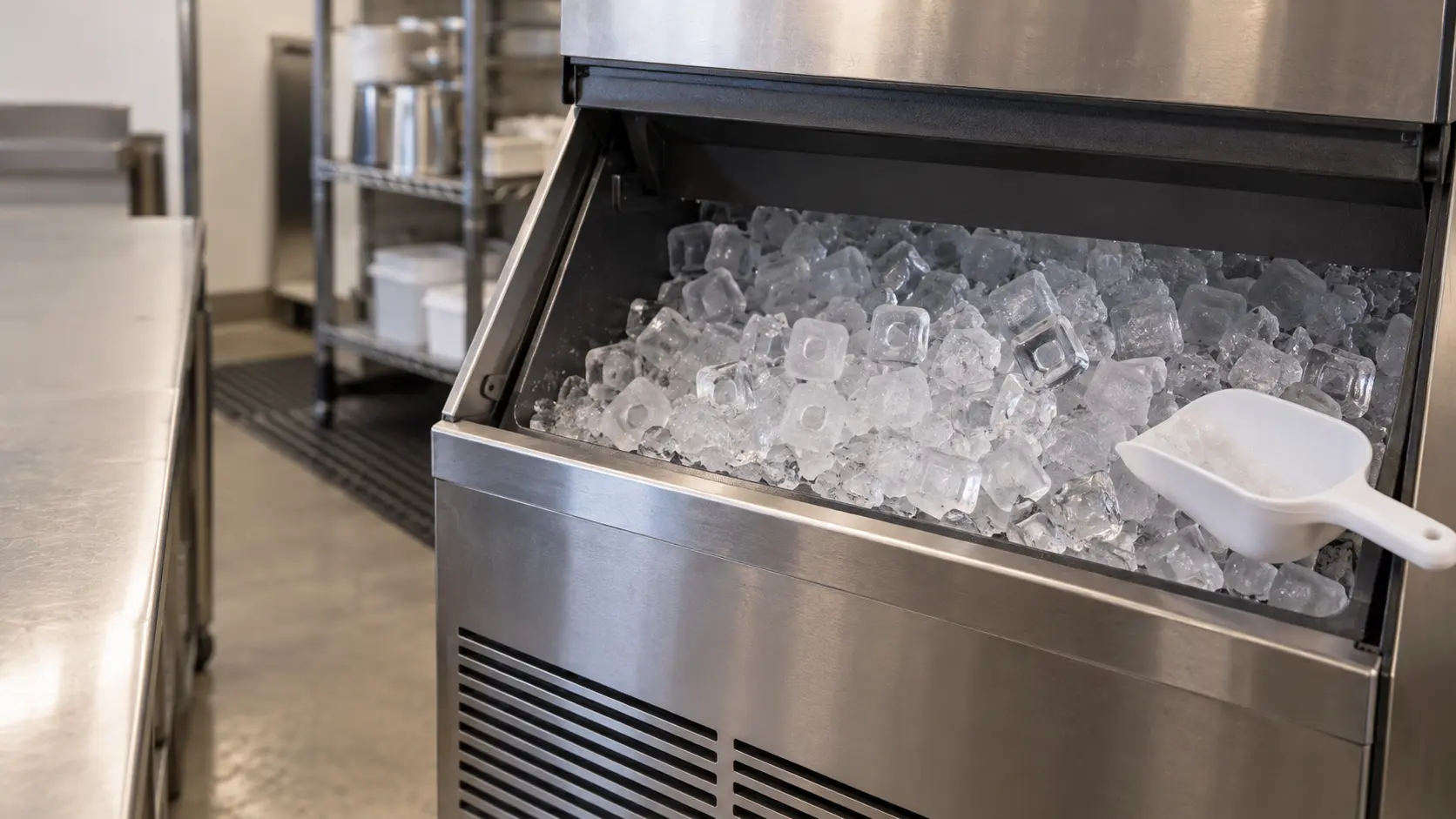
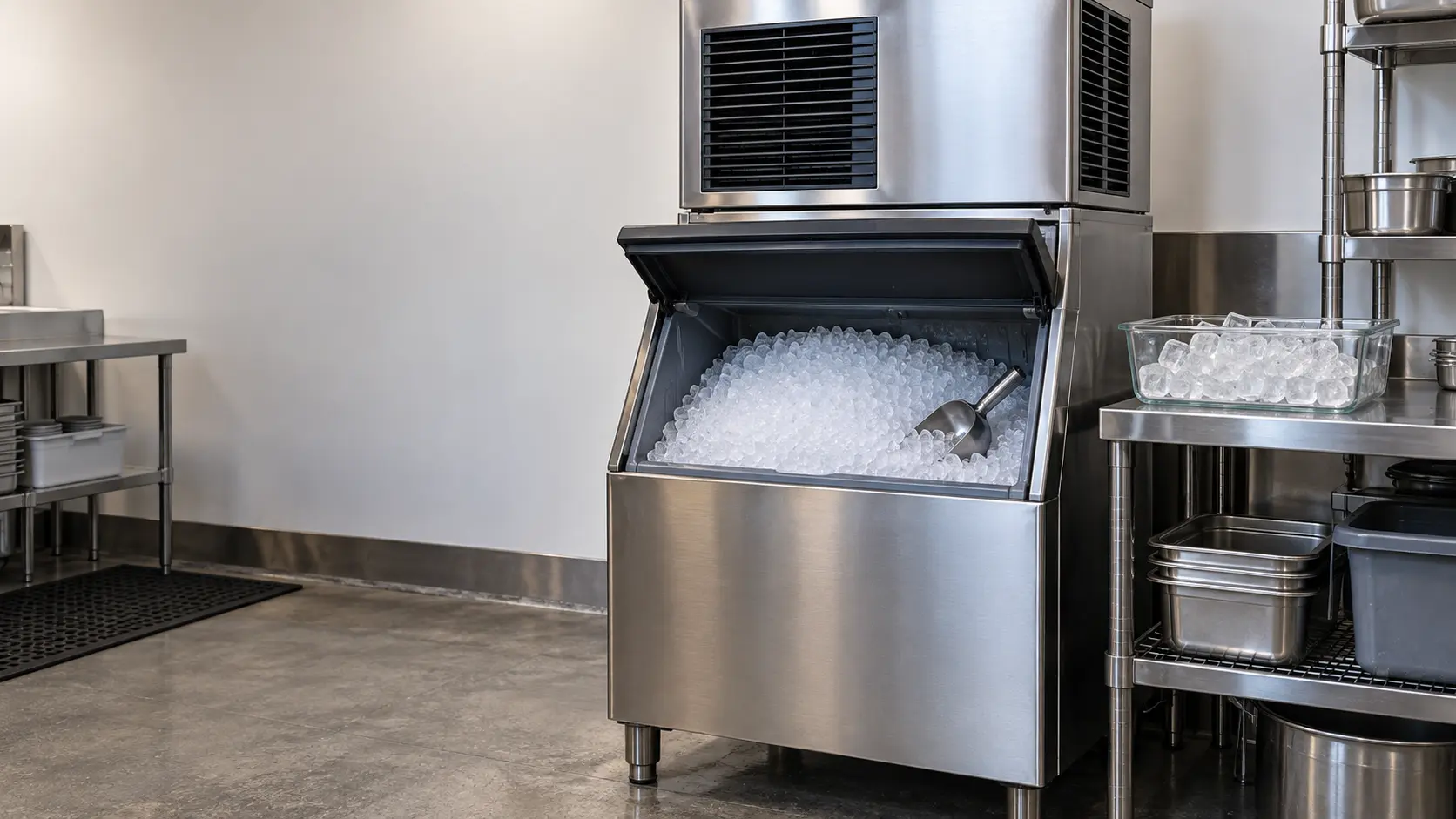
Every commercial ice machine belongs to one of two families. A batch machine runs water over a cold evaporator plate until a slab of cubes has grown to the right thickness, then warms the plate briefly so the slab lets go and falls into the bin. A continuous machine never pauses for a harvest. Its evaporator is a tube with a screw-shaped auger inside; ice forms on the cold tube wall, and the rotating screw scrapes it loose and lifts it out the top.
That difference explains almost everything an owner notices later, from how the ice looks in a glass to which parts wear and how much water goes down the drain. The federal buyer guidance from the Department of Energy puts it plainly: cube ice is made in batch machines, while flake and nugget ice come from the continuous process.
What happens during a batch cycle
Water circulates from a trough over the plate, and what does not freeze runs back to be pumped over again. Minerals stay behind in that leftover water, which is why cubes come out clear and why part of the water is drained away every cycle. A thickness probe or a timer decides when the slab is ready, and a short harvest drops the slab before freezing starts again.
What happens inside an auger machine
Water feeds the cylinder from a small reservoir held at a fixed level. The ice leaves as a steady stream while the compressor and gear motor run together, so there is no pause and very little water is sent to the drain. On a nugget machine the stream is forced through a head that compacts it into pellets; on a flake machine it leaves loose.
Source: U.S. Department of Energy, FEMP — Purchasing Energy-Efficient Air-Cooled Ice Machines — Cube ice is harder and clearer and made in batch machines that use more water; flake ice is softer and cloudier and used in food displays; nugget ice is compressed flake, easier to chew and used in health care; flake and nugget come from a continuous process
What each kind of ice does in the glass, on the tray and in the cup
The three kinds behave differently once they leave the ice bin, and the table below sets out the differences that matter in daily use. None of them is better in general; each one is better at a job.
- A bar serving spirits over ice usually wants cubes: clear, dense and slow to water a drink down.
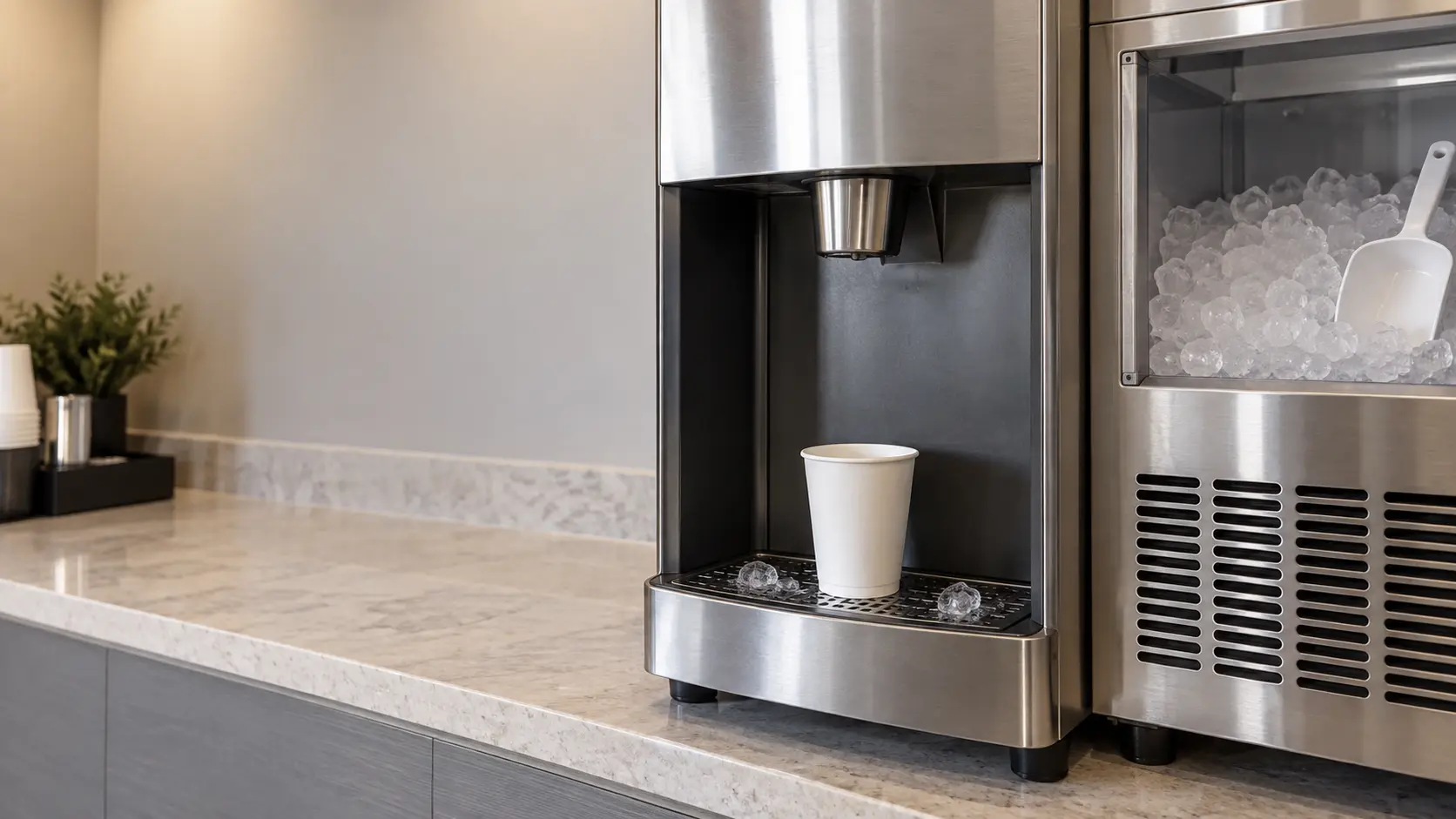
- A soda fountain, a café or a staff break room often prefers nugget ice, which cools fast and is pleasant to chew.
- A seafood counter, a salad bar or a produce display needs flake ice that packs around the food.
- A patient floor tends toward nugget ice, which is easy to chew and swallow.
| Cube | Nugget | Flake | |
|---|---|---|---|
| How it is made | Batch: freeze, then harvest | Continuous, then compressed | Continuous, left loose |
| Look and feel | Hard and clear | Soft, airy and chewable | Soft, wet and cloudy |
| In a drink | Melts slowly, dilutes least | Cools fast, soaks up flavor | Rarely used in drinks |
| On a display | Too hard to bed food in | Workable for small trays | Molds around fish and produce |
| Through a dispenser | Yes, on cube dispensers | Yes | No |
Source: U.S. Department of Energy, FEMP — Purchasing Energy-Efficient Air-Cooled Ice Machines — Cube ice is harder and clearer and made in batch machines that use more water; flake ice is softer and cloudier and used in food displays; nugget ice is compressed flake, easier to chew and used in health care; flake and nugget come from a continuous process

How upkeep and running costs change with the ice
A batch machine sends part of its water to the drain every cycle on purpose, to carry away the minerals that would otherwise coat the plate. The Department of Energy notes that cube machines therefore use more water than the continuous kind, and ENERGY STAR sets separate water limits for the two processes: no more than 20 or 25 gallons per 100 pounds of cubes, depending on the design, against 15 for continuous machines.
An auger machine saves water but carries moving parts a cube machine does not have. The gear motor, the auger and the bearing at the top of the cylinder all take load every minute the machine runs, and scale inside the cylinder makes the auger work harder still.
Checks an auger machine adds to the calendar
Scotsman's manual for its modular flake and nugget machines asks for scale removal at least twice a year, and as often as every three months in some water. It adds a check of the top bearing at least twice a year and a wipe of the bin-level photo eyes, so the machine can still see when the bin is full.
Source: U.S. Department of Energy, FEMP — Purchasing Energy-Efficient Air-Cooled Ice Machines — Cube ice is harder and clearer and made in batch machines that use more water; flake ice is softer and cloudier and used in food displays; nugget ice is compressed flake, easier to chew and used in health care; flake and nugget come from a continuous process; ENERGY STAR — Commercial Ice Maker Key Product Criteria, Version 3.0 — Potable water limits of 20 or 25 gallons per 100 lb for air-cooled batch machines and 15 gallons per 100 lb for continuous machines
Matching the room, the service and the ice
Start from what the ice will touch. If it goes into glasses that customers look at, clarity and slow melting count most, and a cube machine on a bin is the usual answer. If it goes into cups at a self-serve station, the dispenser decides the question, because the ice has to travel through a chute and an agitated hopper without bridging into a solid block.
Space and noise count as well. A nugget machine hums steadily rather than cycling, which suits a quiet office less well than people expect, while a cube machine makes a short clatter at every harvest. Both kinds come as a head on a bin, as a self-contained undercounter unit and, for nugget ice, as a countertop dispenser.
Why flake ice stays out of dispensers
Scotsman's installation manual for the same flake and nugget series states that only the nugget models may be placed on its ice dispensers, because flaked ice is not dispensable. Loose flake packs down and freezes together in a hopper, so it is scooped from a bin instead.
Changing the ice later means changing the machine
There is no kit that turns a cube machine into a nugget machine; the evaporator, the harvest system and the controls are different parts altogether. Some cube machines offer more than one cube size, and a smaller cube can be a reasonable middle ground for a place that serves both cocktails and soft drinks.
If a business outgrows its ice, the head can often be swapped while the bin stays, as long as the new head is approved by its maker for that bin. We can tell you on a visit whether the existing bin, drain and water line will suit the new machine, which saves an unpleasant surprise on delivery day.
- The new head is listed by its maker for the bin or dispenser you already own.
- The bin's liner, door and gasket are sound enough to keep for years.
- The drain, water line and power circuit suit the new head's requirements.
- The room can take the heat of a larger air-cooled head, or a remote condenser has somewhere to go.