
What a dirty condenser does to an ice machine
Manitowoc sums it up in its maintenance section: a dirty condenser restricts airflow, which drives operating temperatures too high, reduces ice production and shortens component life. The machine does not stop; it simply takes longer to freeze each slab, runs the compressor harder and turns out less ice by the end of the day.
Because the change is gradual, it is often noticed first as a bin that is no longer full at opening time or as a compressor that seems to run without a break. When Manitowoc's troubleshooting table explains low capacity, a dirty condenser and overheated intake air are both on it, so we rule them out before suspecting any part.
- Kitchens with fryers and grills coat the coil with grease that holds on to dust.
- Bakeries and pizza rooms add flour, which packs between fins.
- Carpeted offices and hotel corridors send lint to undercounter grilles.
- Machines on the floor near a mop sink pull in damp dust.
Source: Manitowoc — Indigo NXT Ice Machines Installation, Operation and Maintenance Manual — Dirty condenser restricts airflow, raises temperatures, cuts production and shortens component life; filter monthly with mild soap and water; disconnect power; condenser at least every six months, flashlight check, compressed air or water inside out, call service if dirt remains; water-cooled condenser cleaning and regulating valve check; nothing in front of the machine; clearances; 35–110°F air
Start with the filter in front of the coil
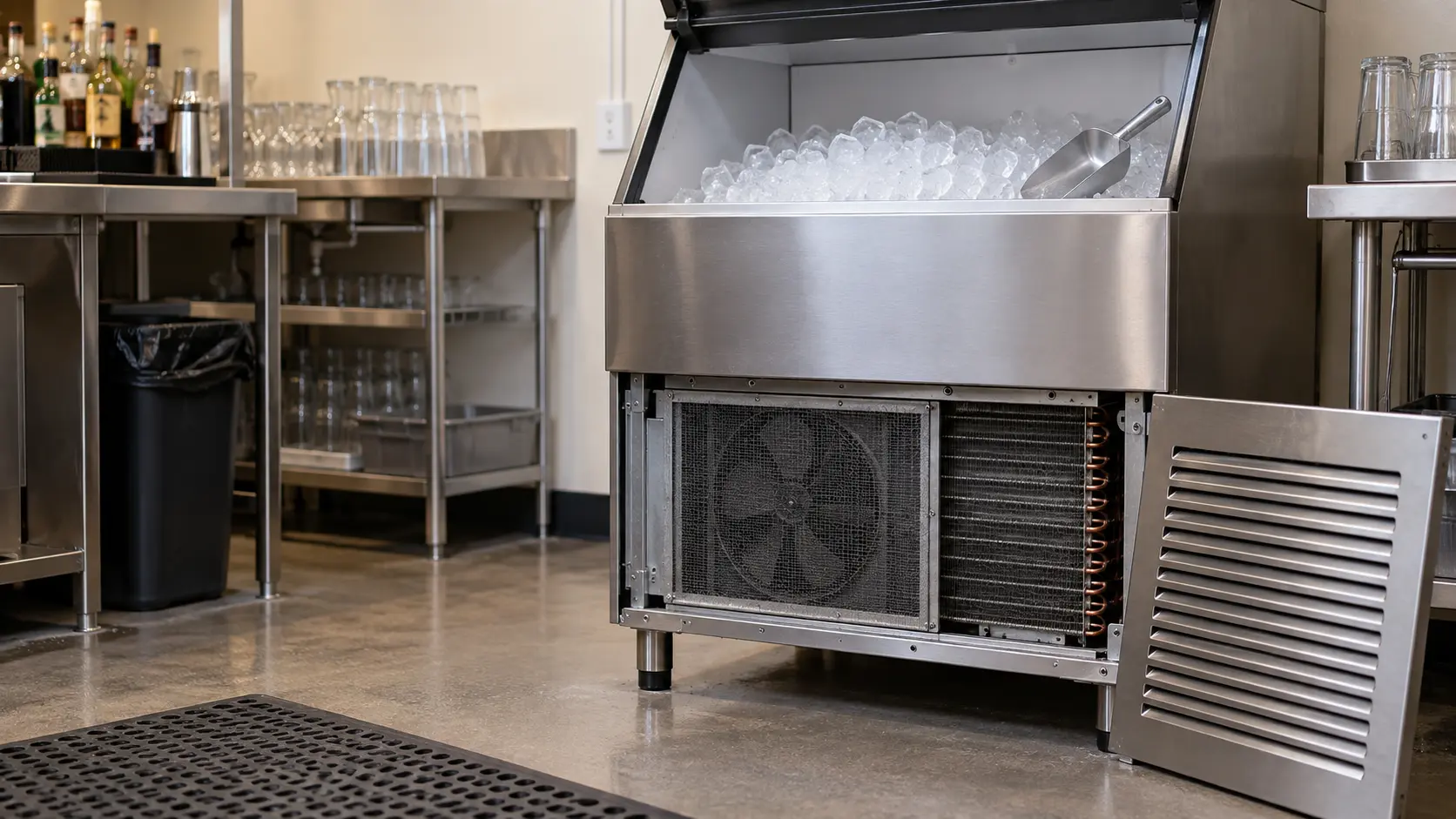
Many self-contained air-cooled machines protect the coil with a washable filter that slides out of the front panel. Manitowoc describes it as the catch for dust, dirt, lint and grease and wants it washed every month in a mild soap solution. Scotsman's flake and nugget manual asks for filter cleaning at least twice a year, monthly in dusty or greasy air, and its cube manual says to clean the filters whenever they look dirty.
Never run the machine without it
Scotsman is firm that the machine should not run without its filter except during cleaning. If it has, the coil under the fan blades collects the dirt the filter would have caught, and Scotsman says a technician is then needed to clean the condenser. Let the washed filter dry, then slide it back before power goes on.
Source: Manitowoc — Indigo NXT Ice Machines Installation, Operation and Maintenance Manual — Dirty condenser restricts airflow, raises temperatures, cuts production and shortens component life; filter monthly with mild soap and water; disconnect power; condenser at least every six months, flashlight check, compressed air or water inside out, call service if dirt remains; water-cooled condenser cleaning and regulating valve check; nothing in front of the machine; clearances; 35–110°F air; Scotsman — Installation and User's Manual, Modular Flake and Nugget Ice Machines, Prodigy Plus A Series — Air filters at least twice a year, monthly in dusty or greasy air; do not run without the filter; fins under the fan need a technician if run without a filter; check the remote coil at every cleaning; Scotsman — Installation and User's Manual, Modular Cuber Prodigy Plus E Series — Clean air filters when visibly dirty; do not operate without the filter; a refrigeration technician is needed to clean fins under the fan blades

Cleaning the condenser coil itself
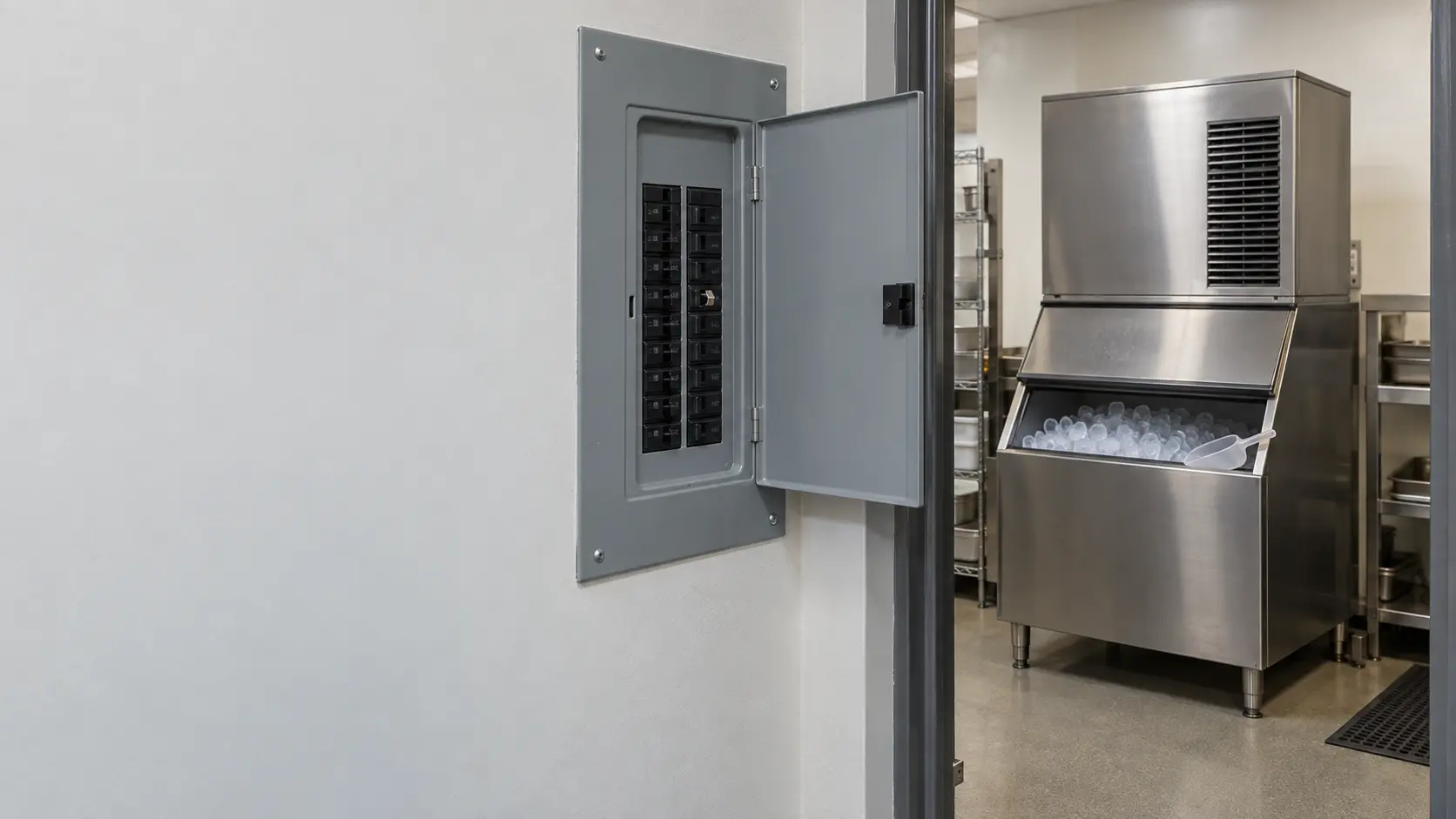
Switch the machine off and disconnect power at the service switch or breaker first; Manitowoc's warning covers both the filter and the condenser. Then hold a flashlight to the far side of the coil and look through the fins. Manitowoc suggests this as the check for dirt packed between the fins; a matted gray face means it is time.
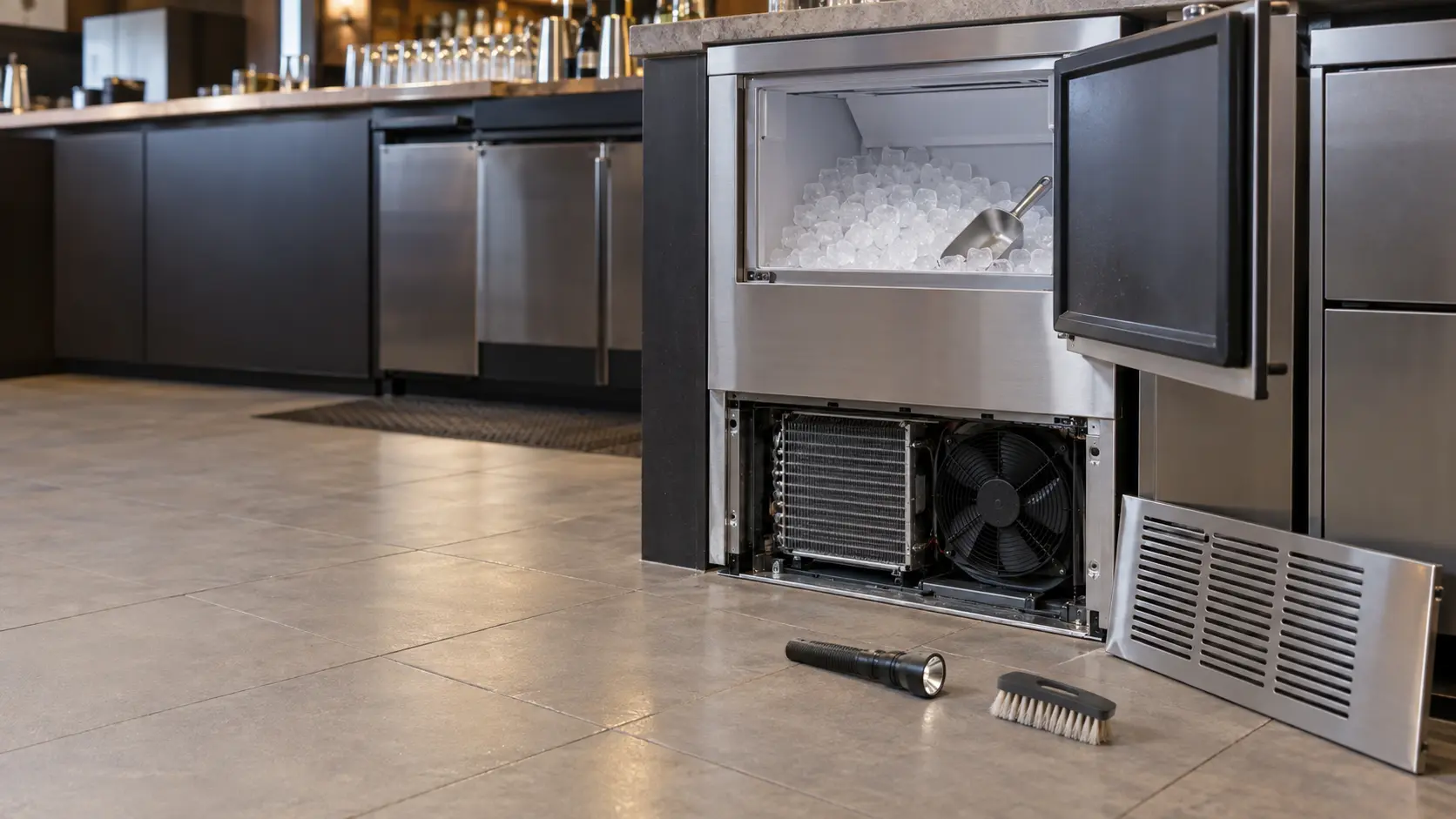
Manitowoc allows compressed air or rinsing with water from the inside out, against the normal direction of airflow, and says to call a service agent if dirt remains afterward. U-Line, for its clear ice machine behind a front grille, sets a six-month interval and permits only a vacuum, a soft brush or compressed air, and says no cleaner of any kind goes on the condenser. Its manual also warns not to touch the fins, which are sharp and bend easily.
Undercounter units behind a grille
On an undercounter ice machine the coil sits behind the toe-kick grille, drawing air from the floor. On U-Line's clear ice unit the grille comes off with two screws after the power is disconnected, and the manual asks for it to be back in place whenever the unit is in use.
What to leave alone
Straightening bent fins, reaching past the fan blade or washing a coil with chemicals are jobs for a technician. So is any condenser that cannot be reached from the front without moving the machine.
Source: Manitowoc — Indigo NXT Ice Machines Installation, Operation and Maintenance Manual — Dirty condenser restricts airflow, raises temperatures, cuts production and shortens component life; filter monthly with mild soap and water; disconnect power; condenser at least every six months, flashlight check, compressed air or water inside out, call service if dirt remains; water-cooled condenser cleaning and regulating valve check; nothing in front of the machine; clearances; 35–110°F air; U-Line — User Guide and Service Manual, Clear Ice Machine U-CLR1215B — Condenser every six months with vacuum, soft brush or compressed air, no cleaner; disconnect power; fins sharp; grille removed by two screws and refitted before use; operates 50–100°F, away from sun and heat sources
Water-cooled and remote condensers
A water-cooled machine has no fins to brush. Its condenser fouls on the water side instead, which takes a technician, and Manitowoc notes that such machines may need the condenser cleaned and the water regulating valve checked. Water running from the condenser drain during harvest can mean the valve is out of adjustment.
A remote condenser works outdoors, usually on a roof, where leaves, cottonwood fluff and grease from a kitchen exhaust land on it. Scotsman asks for the remote coil to be checked every time the machine is cleaned. Roof work and the fan's power supply make that a job for us rather than for staff.
Source: Manitowoc — Indigo NXT Ice Machines Installation, Operation and Maintenance Manual — Dirty condenser restricts airflow, raises temperatures, cuts production and shortens component life; filter monthly with mild soap and water; disconnect power; condenser at least every six months, flashlight check, compressed air or water inside out, call service if dirt remains; water-cooled condenser cleaning and regulating valve check; nothing in front of the machine; clearances; 35–110°F air; Scotsman — Installation and User's Manual, Modular Flake and Nugget Ice Machines, Prodigy Plus A Series — Air filters at least twice a year, monthly in dusty or greasy air; do not run without the filter; fins under the fan need a technician if run without a filter; check the remote coil at every cleaning
Keep the air around the machine moving
A spotless coil still struggles if the air reaching it is hot or trapped. Manitowoc asks that nothing, boxes included, be placed in front of the machine and that there be adequate airflow through and around it. Its clearance table asks for 8 inches above and beside many models and 5 inches behind, with more for some larger heads; your own model's line in that table is the figure that counts.
The room's own temperature has limits as well. U-Line rates its clear ice machine for 50°F to 100°F and asks for it to be kept out of direct sun and away from equipment that gives off heat; Manitowoc's heads tolerate a wider band, down to 35°F and up to 110°F.
- No boxes, cases or bags stacked against the vents or the kick space.
- No oven, fryer or dish machine exhaust blowing toward the intake.
- Door of a closet or alcove left open, or a vent in it, if the machine is air-cooled.
- Space kept at the sides, top and back as the model's table gives.
Source: Manitowoc — Indigo NXT Ice Machines Installation, Operation and Maintenance Manual — Dirty condenser restricts airflow, raises temperatures, cuts production and shortens component life; filter monthly with mild soap and water; disconnect power; condenser at least every six months, flashlight check, compressed air or water inside out, call service if dirt remains; water-cooled condenser cleaning and regulating valve check; nothing in front of the machine; clearances; 35–110°F air; U-Line — User Guide and Service Manual, Clear Ice Machine U-CLR1215B — Condenser every six months with vacuum, soft brush or compressed air, no cleaner; disconnect power; fins sharp; grille removed by two screws and refitted before use; operates 50–100°F, away from sun and heat sources