
Where scale forms inside an ice machine
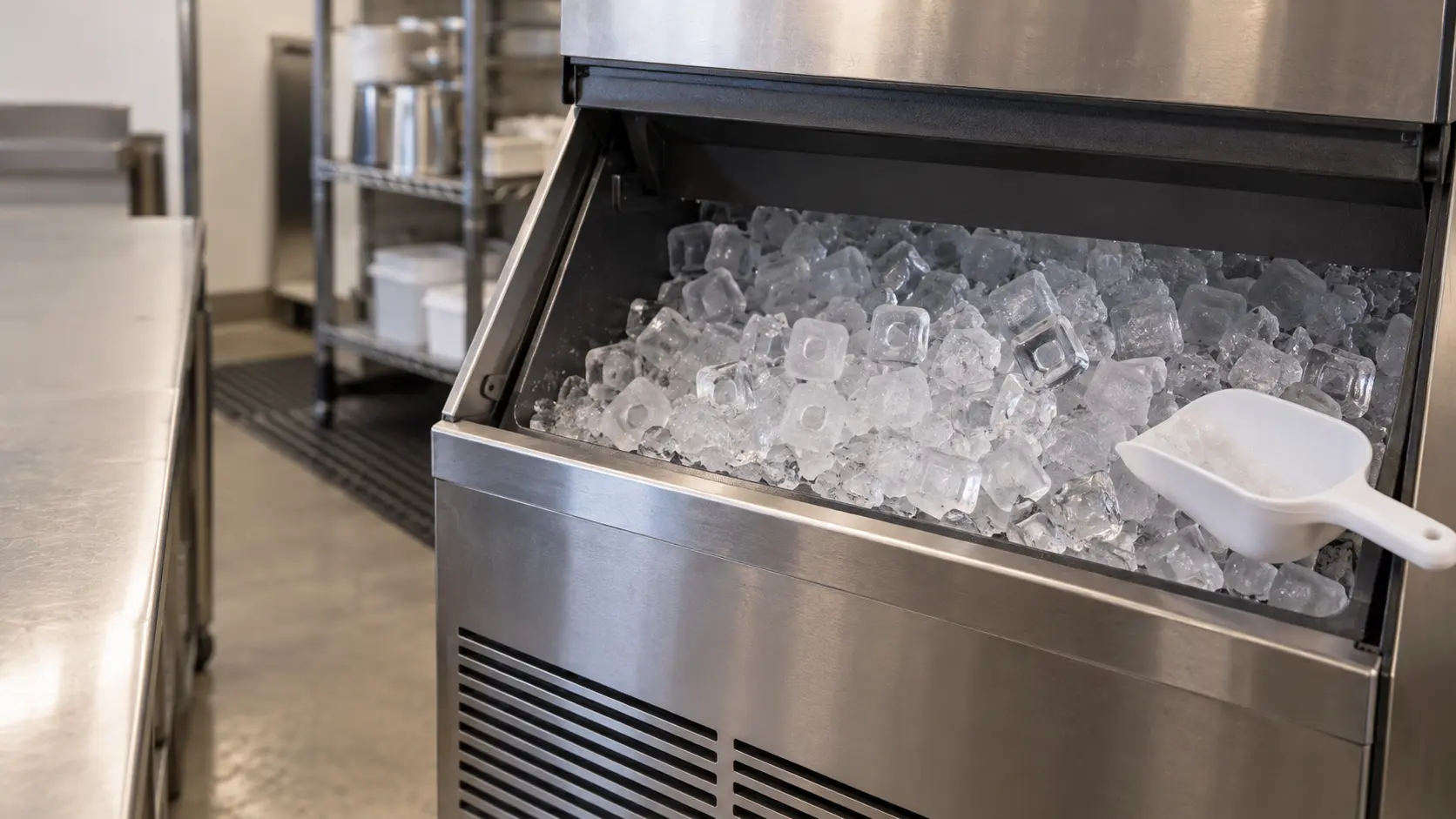
When water freezes on a cube plate, the ice that forms is nearly pure; the minerals stay in the water that runs back to the trough. Each cycle that trough water gets harder, and some of what it carries settles out as a pale crust on the evaporator, the distributor holes, the water pump and the probes that measure water level and ice thickness.
The effects creep in slowly. Cubes release late because the crust grips them, a crusted thickness probe can hold the machine in the freeze and delay the harvest, and level probes coated in minerals need wiping to read the trough correctly. On nugget and flake machines the same crust forms inside the freezing cylinder, where it makes the auger work harder.
The purge: water sent to the drain on purpose
Cube machines drain part of the trough water every cycle to carry concentrated minerals away. Scotsman's manual calls this the water purge, notes that an effective purge lengthens the time between cleanings, and says its E series can vary the purge with the purity of the incoming water or have it set by hand. A purge set too low saves water and costs scale.
Automatic rinse settings
Many commercial machines also rinse the water system on a schedule. The Department of Energy notes that the frequency of that function can usually be adjusted to local water, and that machines are commonly found set to maximum regardless of water quality. The setting is worth checking with the manual, since every extra rinse uses water.
Source: Scotsman — Installation and User's Manual, Modular Flake and Nugget Ice Machines, Prodigy Plus A Series — Filter only the water to the reservoir, not the water-cooled condenser; RO water at least 10 microsiemens/cm; wipe the water probe clean of mineral build-up at least twice a year; Manitowoc — Indigo NXT Ice Machines Installation, Operation and Maintenance Manual — Local water may require treatment to inhibit scale, filter sediment and remove chlorine taste and odor; an improperly working softener is listed as a cause of soft or cloudy ice; a dirty ice thickness probe keeps the machine from cycling into harvest
What a filter can and cannot do
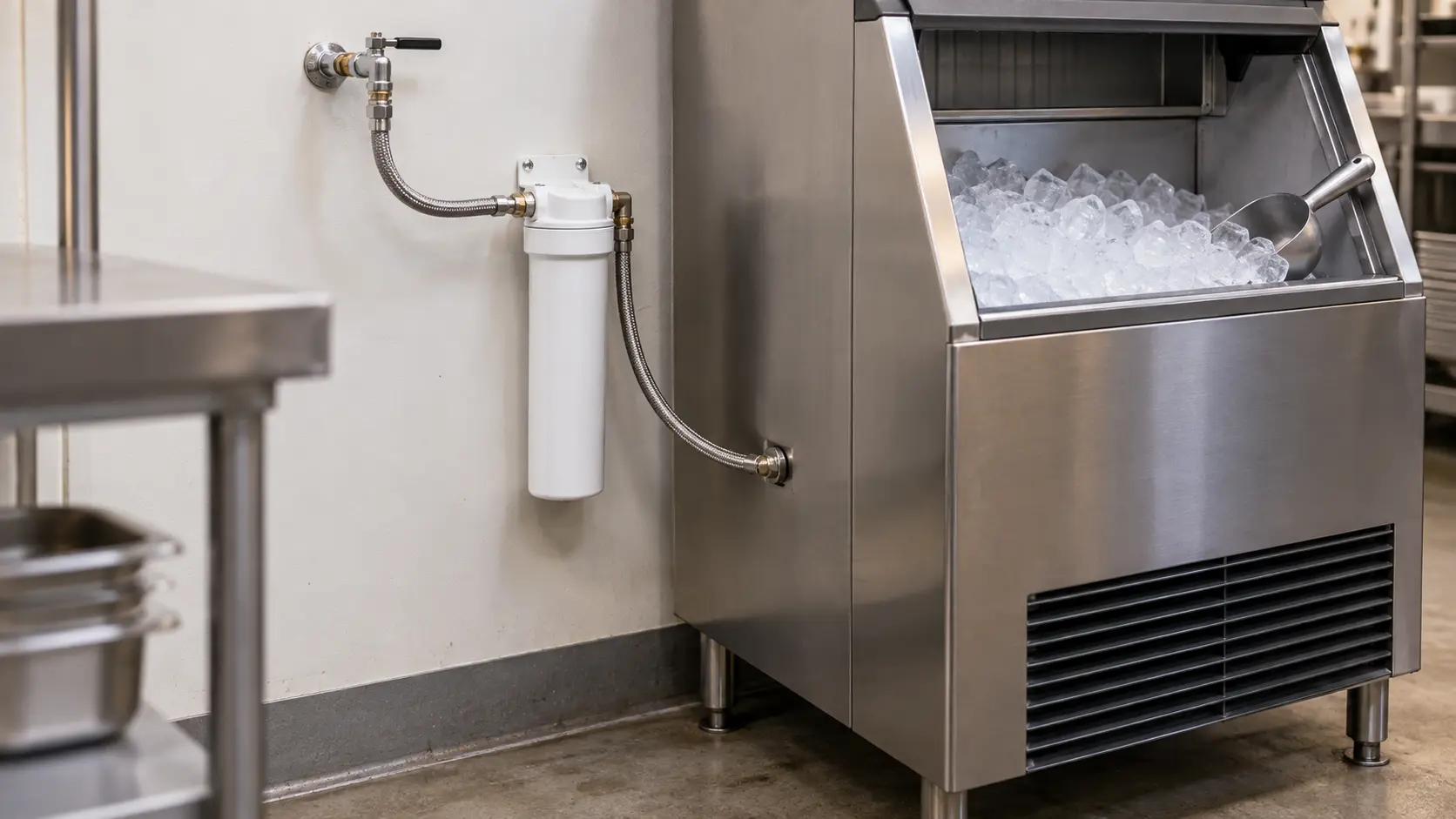
Scotsman's manual draws the line clearly: suspended solids can be filtered out, but dissolved solids cannot and must be diluted or treated. A sediment cartridge protects the inlet valve and distributor from grit; it does nothing about calcium already dissolved in the water.
That is why ice machine cartridges usually add a scale inhibitor. Manitowoc recommends a filtration system with a polyphosphate scale inhibitor for all of its installations and says it significantly reduces how often cleaner is needed in hard water. Local conditions may also call for carbon to remove chlorine taste and odor.
- Sediment: removed by the filter, protects valves and small holes.
- Chlorine taste and odor: reduced by carbon media.
- Hardness minerals: slowed by a polyphosphate inhibitor, not removed.
- Scale already on the plate: untouched by any filter; only descaling removes it.
The chlorine trade-off
Scotsman points out a side effect worth knowing. Most filters strip chlorine from the water, and without that chlorine the machine is more open to contamination, especially near yeast. It notes that its own filter which leaves chlorine in place improves the situation, while the freezing process removes chlorine from the ice itself, so taste is not affected.
Source: Scotsman — Installation and User's Manual, Modular Cuber Prodigy Plus E Series — Suspended solids can be filtered, dissolved solids cannot; water purge each cycle, variable or set manually; filters that remove chlorine raise contamination risk near yeast; change cartridges after six months or on pressure drop; RO water conductivity at least 10 microsiemens/cm; water quality affects product life; Manitowoc — Parts & Service Communicator MII-106, Ice Machine Cleaner and Sanitizer Usage — Filtration with a polyphosphate scale inhibitor is highly recommended and significantly reduces the need for cleaner in hard water; Manitowoc — Indigo NXT Ice Machines Installation, Operation and Maintenance Manual — Local water may require treatment to inhibit scale, filter sediment and remove chlorine taste and odor; an improperly working softener is listed as a cause of soft or cloudy ice; a dirty ice thickness probe keeps the machine from cycling into harvest

Changing the cartridge on time
A filter works until it clogs, and then it starts starving the machine. Scotsman asks owners to check the cartridge date or the pressure gauge on the filter head and to change cartridges after six months in service, or sooner if the pressure drops too much when the machine fills. A starved fill produces short slabs and small or hollow cubes, which is easy to mistake for a failing part.
Filter only the water that becomes ice. Scotsman's installation notes say to filter only the water going to the reservoir, never the condenser circuit on a water-cooled model, and to fit a new cartridge when filters are carried over from an earlier machine. Write the change date on the cartridge head where the next person will see it.
- The date on the cartridge head is more than six months old.
- The gauge needle falls well below its usual reading while the machine fills.
- Cubes come out thinner, smaller or hollow at the center with no other change.
- Grit or dark particles show up in the trough or the inlet valve screen.
Source: Scotsman — Installation and User's Manual, Modular Cuber Prodigy Plus E Series — Suspended solids can be filtered, dissolved solids cannot; water purge each cycle, variable or set manually; filters that remove chlorine raise contamination risk near yeast; change cartridges after six months or on pressure drop; RO water conductivity at least 10 microsiemens/cm; water quality affects product life; Scotsman — Installation and User's Manual, Modular Flake and Nugget Ice Machines, Prodigy Plus A Series — Filter only the water to the reservoir, not the water-cooled condenser; RO water at least 10 microsiemens/cm; wipe the water probe clean of mineral build-up at least twice a year
Reverse osmosis, softeners and very pure water
Very clean water is not automatically better. Scotsman accepts reverse osmosis water on its cube and nugget machines only if conductivity stays at or above 10 microsiemens per centimeter. Ask whoever maintains the reverse osmosis system to confirm that the water feeding the ice machine meets that figure for your model.
Softened water brings its own issues, and Manitowoc's troubleshooting table lists a softener that is working improperly among the causes of soft or cloudy ice. If ice quality changes after water treatment work in the building, mention it when you book, since it narrows the search.
Source: Scotsman — Installation and User's Manual, Modular Cuber Prodigy Plus E Series — Suspended solids can be filtered, dissolved solids cannot; water purge each cycle, variable or set manually; filters that remove chlorine raise contamination risk near yeast; change cartridges after six months or on pressure drop; RO water conductivity at least 10 microsiemens/cm; water quality affects product life; Scotsman — Installation and User's Manual, Modular Flake and Nugget Ice Machines, Prodigy Plus A Series — Filter only the water to the reservoir, not the water-cooled condenser; RO water at least 10 microsiemens/cm; wipe the water probe clean of mineral build-up at least twice a year; Manitowoc — Indigo NXT Ice Machines Installation, Operation and Maintenance Manual — Local water may require treatment to inhibit scale, filter sediment and remove chlorine taste and odor; an improperly working softener is listed as a cause of soft or cloudy ice; a dirty ice thickness probe keeps the machine from cycling into harvest