

Why a technician asks for both numbers
The model number says what the machine is: its series, size, cube shape, cooling type and electrical supply. The serial number says which one it is, and with it the build date and the revision of parts inside. Two machines with identical model numbers can take different control boards or water valves if they were built years apart, which is why a parts counter asks for both.
Having the ice machine model and serial number ready when you book also answers the questions that decide the visit: whether the unit is air-, water- or remote-cooled, what voltage it runs on, and whether it carries a flammable refrigerant that calls for a technician qualified on it.
Where the plates are on each kind of machine
Start with whatever you can read without moving anything. On current touch-screen machines that is the screen itself: Manitowoc's Indigo NXT shows model, serial number and installation date behind its information icon. On machines with lights instead of a screen, the dataplate on the back is the next place, which is easy on a modular head that sits above counter height and harder on an undercounter unit built into a bar.
- Modular head on a bin: dataplate on the back of the head; a second tag behind the front panel on Scotsman.
- Self-contained undercounter cuber: back dataplate plus a tag behind the front panel.
- Remote-cooled system: the head carries the serial plate with the full refrigerant charge; the remote condenser on the roof has its own plate.
- Ice bin or dispenser: its own plate, typically at the rear or just inside the front opening, separate from the head.
- Residential undercounter and nugget units: often inside the door frame or on the back; the use and care guide shows where.
An undercounter machine built into a bar
Do not pull an undercounter ice machine out of its opening to read the back. It is connected to water, a drain and power, and the lines are short. Look for the plate inside the door frame first, check the paperwork from the installation, and if neither works, leave it for the visit.
The tag behind the front panel
Scotsman places a model and serial tag behind the front panel as well as on the back. That panel covers the evaporator and control area, so it is read at the visit or, if the manual shows it as an owner-removable panel, only after the disconnect has cut power to it. Nothing in this guide needs a panel off over live wiring.
Source: Scotsman — C1448 and C1848 modular cuber installation and user's manual — Model number on the back dataplate and on the model and serial tag behind the front panel; C1448SA-32E decoding: cuber, capacity in hundreds of pounds, cabinet width, cube size, condenser type, electrical code, series; Scotsman — CU1526, CU2026, CU3030 self-contained Prodigy cuber manual — Back dataplate and serial tag behind the front panel; CU2026 capacity coded in tens of pounds; Manitowoc — Indigo NXT ice machines, installation, operation and maintenance manual — Information icon shows model, serial number and installation date; model number key with P for R290, R for R404A, T for R410; A, W, N condenser codes; voltage suffix; refer to the nameplate for refrigerant type; remote machines carry the serial plate with the total charge in the head

Reading what the model string says
Most makers build their model numbers from codes, and knowing a few of them helps you confirm you are reading the right plate. Scotsman's C1448SA-32E breaks down as a cuber, nominal capacity of 1,400 pounds, a 48-inch cabinet, small cube, air-cooled, 208 to 230 volt single phase, fifth series. On its undercounter CU2026, the 20 means a nominal 200 pounds, because that series counts in tens rather than hundreds.
Manitowoc's Indigo models start with I for Indigo, then a letter for cube size, one for refrigerant and a letter for condenser type. In its key, P means R-290, R means R404A and T means R410A; A is self-contained air-cooled, W water-cooled and N remote air-cooled. A three-digit suffix gives the voltage.
The refrigerant is on the plate
Manitowoc tells owners to check the nameplate to identify the refrigerant in their machine. Where the plate says R-290, that matters for everyone who works near it: Scotsman's residential manual warns the refrigerant is flammable and asks that no open ignition source be installed beside the machine. Knowing it before a visit means the right technician comes.
Source: Scotsman — C1448 and C1848 modular cuber installation and user's manual — Model number on the back dataplate and on the model and serial tag behind the front panel; C1448SA-32E decoding: cuber, capacity in hundreds of pounds, cabinet width, cube size, condenser type, electrical code, series; Scotsman — CU1526, CU2026, CU3030 self-contained Prodigy cuber manual — Back dataplate and serial tag behind the front panel; CU2026 capacity coded in tens of pounds; Manitowoc — Indigo NXT ice machines, installation, operation and maintenance manual — Information icon shows model, serial number and installation date; model number key with P for R290, R for R404A, T for R410; A, W, N condenser codes; voltage suffix; refer to the nameplate for refrigerant type; remote machines carry the serial plate with the total charge in the head
Faded, missing or painted-over plates
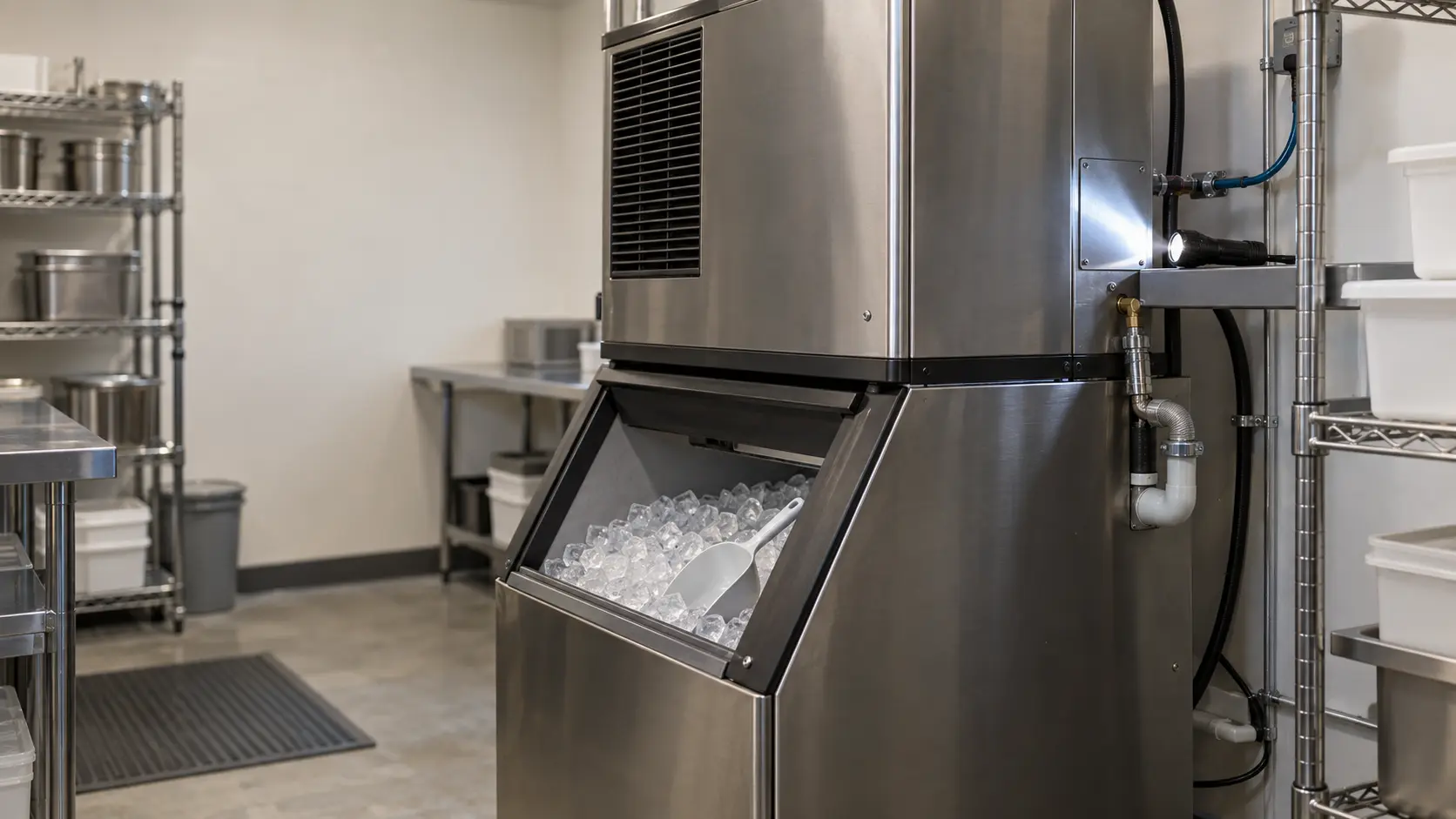
Plates in a hot back room fade, and stickers on a bin get scrubbed off with years of cleaning. Photograph the plate in raking light from a flashlight held to one side, which shows embossed characters that flat light hides. If the plate is gone, the original invoice, a service sticker from an earlier visit or the maker's warranty registration may carry the numbers.
When nothing survives, a technician can often identify the machine from its layout, its evaporator and the part numbers printed on internal components. That takes longer and may mean a second trip for parts, so say on the booking that the plate is missing and attach photos of the whole machine, the front panel and the connections at the back.
- The original sales invoice or the installer's paperwork.
- A service sticker left inside the bin door or on the side panel by an earlier visit.
- The maker's product registration confirmation, if the machine was registered.
- The filter head, which sometimes carries a label written up at installation with the machine's details.


