
Every pound of ice puts heat into the room
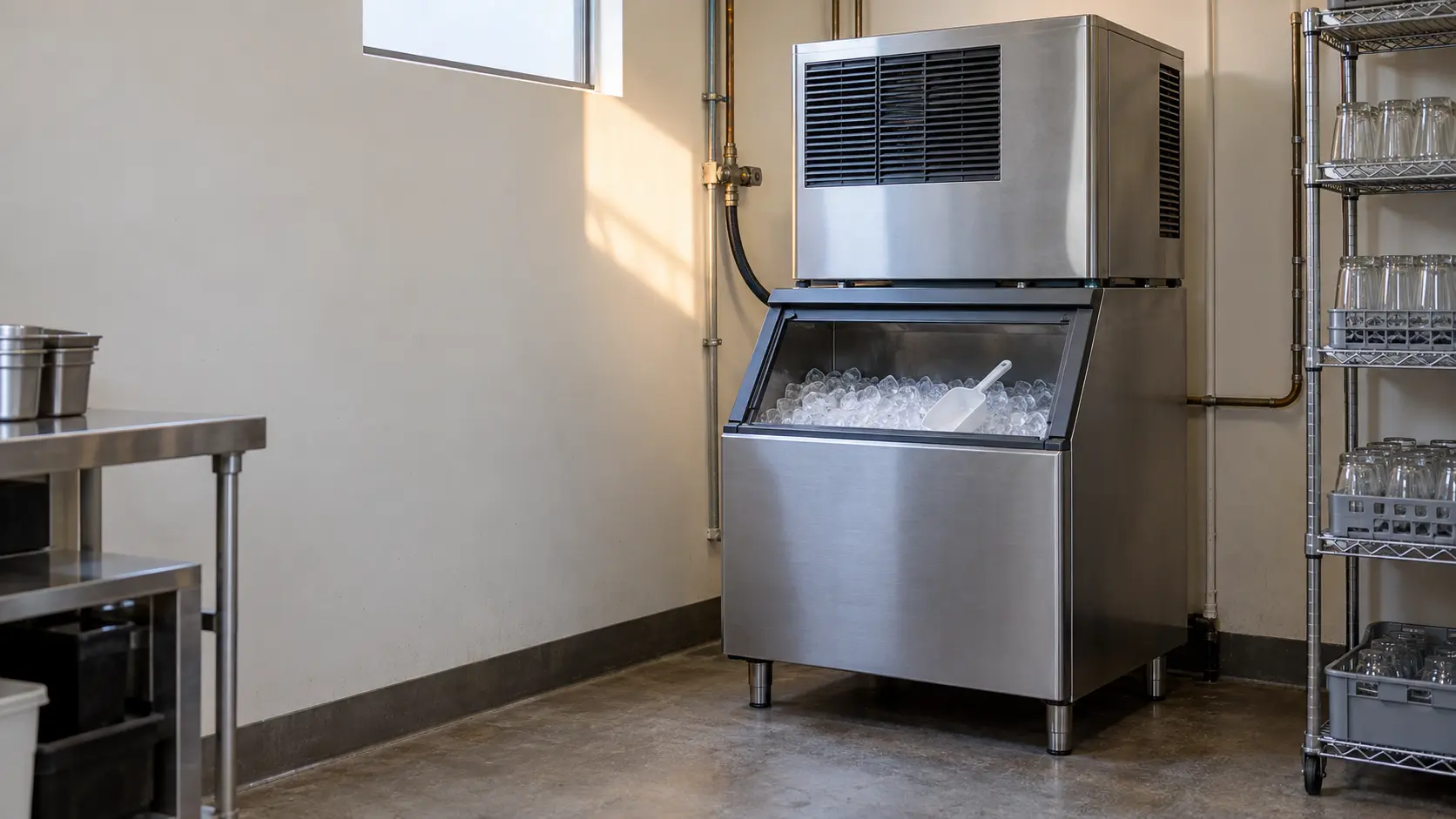
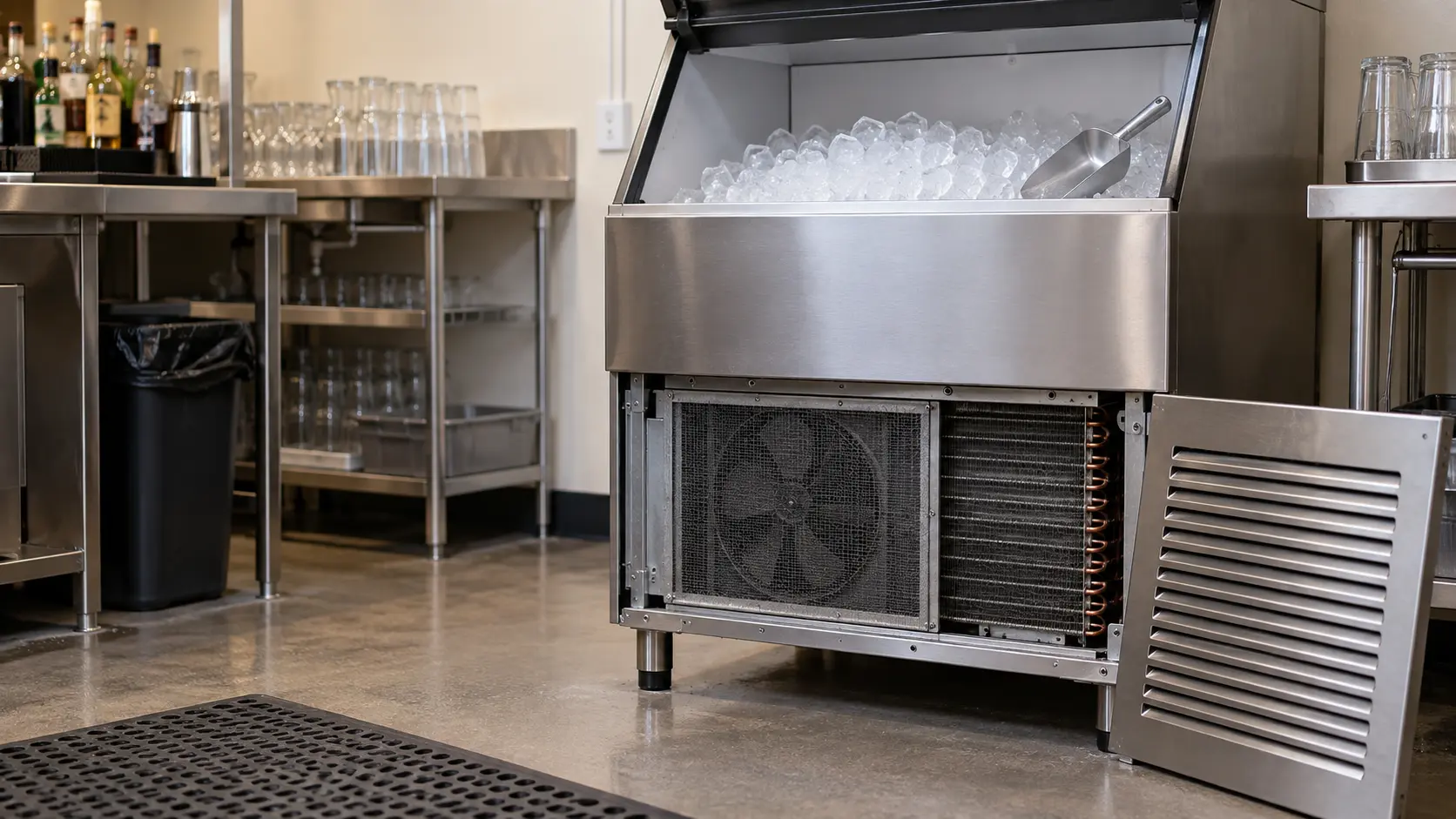
An ice machine is a heat pump pointed at a tray of water. The warmth it pulls out of the water, plus the work of its compressor, leaves through the condenser. On an air-cooled model the condenser is a finned coil with a fan, and the heat goes into whatever air is around the cabinet.
Manitowoc publishes the heat of rejection for its flake and nugget machines so that air conditioning can be sized for it. On air-cooled models the figures run from about 2,400 Btu per hour for a small undercounter unit to about 17,000 for the largest modular head in the table. Water-cooled and remote condensers, Manitowoc notes, add a negligible amount of heat to an air-conditioned room.
Why a hot corner gets hotter
In a closet, a tight alcove or a bar cabinet with no exhaust path, the machine breathes its own exhaust. The air entering the condenser gets warmer with every cycle, the gas cannot shed its heat, and the machine runs longer to make the same sheet of ice. The owner sees a bin that fills slowly on the busiest afternoons and blames the machine.
Source: Manitowoc — Flake and Nugget Ice Machines UFK, UNK, RFK, RNK: Installation, Operation and Maintenance Manual — Heat of rejection from about 2,400 to 17,000 Btuh on air-cooled models, negligible for water-cooled or remote; air 10–43°C, water 3–32°C; clearances by model type; top panel removal for descaling; not near heat-generating equipment or sunlight; no flammable vapors nearby
The room and water temperatures makers allow
Every installation manual gives an operating band for the room and for the incoming water, and a machine outside it is outside what the maker designed for. The figures below are from the manuals we checked; your own model's plate and manual take priority.
- Scotsman undercounter cube models CU0415X to CU0920X: room air 50°F to 100°F, water 40°F to 100°F, water pressure 15 psi dynamic to 80 psi static.
- Scotsman residential SRC035: the same air and water band, and the note that it works best in rooms between 70°F and 80°F.
- Manitowoc flake and nugget machines: room air from 10°C to 43°C, about 50°F to 110°F, and water from 3°C to 32°C, about 37°F to 90°F.
- Both makers: indoors only, and not in direct sunlight or near heat-generating equipment.
Too cold matters as well
A machine in an unheated storeroom or a winter porch can stop for the opposite reason. Scotsman says its cube machines will not switch on to make ice below their minimum room temperature, and that in a cold room the fan may cycle on and off during the freeze, which is normal. A bin that stays empty every January morning is often a room problem rather than a failed part.
Source: Manitowoc — Flake and Nugget Ice Machines UFK, UNK, RFK, RNK: Installation, Operation and Maintenance Manual — Heat of rejection from about 2,400 to 17,000 Btuh on air-cooled models, negligible for water-cooled or remote; air 10–43°C, water 3–32°C; clearances by model type; top panel removal for descaling; not near heat-generating equipment or sunlight; no flammable vapors nearby; Scotsman — Installation and User's Manual, Cube Ice Machines with Storage CU0415X, CU0715X, CU0920X — Air 50–100°F, water 40–100°F, 15–80 psi; will not run below minimum room temperature; 1/8 inch side, 1/4 inch top, 4 inch back; panels removed for service; no flame, gas appliance, heater or vibration nearby; cycle times at 70/50°F and 90/70°F; Scotsman — Installation and User's Manual, Residential Ice Machine SRC035 — Operates between 50°F and 100°F and functions best between 70°F and 80°F

Clearance around the cabinet, by kind of machine
Undercounter machines that breathe through the front grille can sit almost touching their neighbors. Scotsman's cube models ask for only 1/8 inch at the sides and 1/4 inch on top, 4 inches at the back for the connections, and louvers at the front that are never blocked. Manitowoc's undercounter flake and nugget units want no gap on top, about 2 inches at the sides and about 8 inches behind.
Modular heads that exhaust through the top and sides need more. Manitowoc's air-cooled modular flake and nugget heads call for about 8 inches at the top and sides and about 5 inches at the back, while its remote condensing units ask for about 24 inches front and back. A kick panel, a shelf or a stack of cases pushed against the grille cancels all of it.
Leave room to service it
Manitowoc notes that on a built-in undercounter unit the top panel has to come off for descaling and sanitizing, and that allowance must be made for removal. Scotsman warns that some procedures need the top, back and side panels off. A machine fitted so tightly that it cannot slide out turns a routine clean into a counter removal.
Source: Manitowoc — Flake and Nugget Ice Machines UFK, UNK, RFK, RNK: Installation, Operation and Maintenance Manual — Heat of rejection from about 2,400 to 17,000 Btuh on air-cooled models, negligible for water-cooled or remote; air 10–43°C, water 3–32°C; clearances by model type; top panel removal for descaling; not near heat-generating equipment or sunlight; no flammable vapors nearby; Scotsman — Installation and User's Manual, Cube Ice Machines with Storage CU0415X, CU0715X, CU0920X — Air 50–100°F, water 40–100°F, 15–80 psi; will not run below minimum room temperature; 1/8 inch side, 1/4 inch top, 4 inch back; panels removed for service; no flame, gas appliance, heater or vibration nearby; cycle times at 70/50°F and 90/70°F
What should not share the corner
The best spot is a cool, ventilated, dry corner with a floor sink close by. Several things are worth keeping away from any ice machine, and a few more from one that runs on R-290.
- Fryers, ovens, steam tables, dish machine exhaust and water heaters, which heat the air the condenser needs.
- Direct sun through a window or a glass door.
- For R-290 machines, open flames, operating gas appliances and electric heaters, as Scotsman directs.
- Gasoline and other flammable vapors or liquids, which Manitowoc rules out anywhere near the machine.
- Anything that vibrates constantly, such as a compressor rack or a keg cooler, which Scotsman also asks installers to avoid.
Source: Manitowoc — Flake and Nugget Ice Machines UFK, UNK, RFK, RNK: Installation, Operation and Maintenance Manual — Heat of rejection from about 2,400 to 17,000 Btuh on air-cooled models, negligible for water-cooled or remote; air 10–43°C, water 3–32°C; clearances by model type; top panel removal for descaling; not near heat-generating equipment or sunlight; no flammable vapors nearby; Scotsman — Installation and User's Manual, Cube Ice Machines with Storage CU0415X, CU0715X, CU0920X — Air 50–100°F, water 40–100°F, 15–80 psi; will not run below minimum room temperature; 1/8 inch side, 1/4 inch top, 4 inch back; panels removed for service; no flame, gas appliance, heater or vibration nearby; cycle times at 70/50°F and 90/70°F
How to check a spot that is already in use
Put a simple thermometer at the air intake during the busiest hour of a warm day and write the reading down. Then put a hand near the exhaust: if the air leaving feels hardly warmer than the air entering, the coil may be dirty; if the air at the intake is already hot, the machine is breathing its own exhaust.
The Scotsman manual shows why this matters in numbers. Its CU0715X runs a freeze and harvest cycle in 16 to 18 minutes with 70°F air and 50°F water, and in 23 to 26 minutes with 90°F air and 70°F water. Fewer cycles an hour means fewer pounds a day, with nothing broken at all.
Source: Scotsman — Installation and User's Manual, Cube Ice Machines with Storage CU0415X, CU0715X, CU0920X — Air 50–100°F, water 40–100°F, 15–80 psi; will not run below minimum room temperature; 1/8 inch side, 1/4 inch top, 4 inch back; panels removed for service; no flame, gas appliance, heater or vibration nearby; cycle times at 70/50°F and 90/70°F


