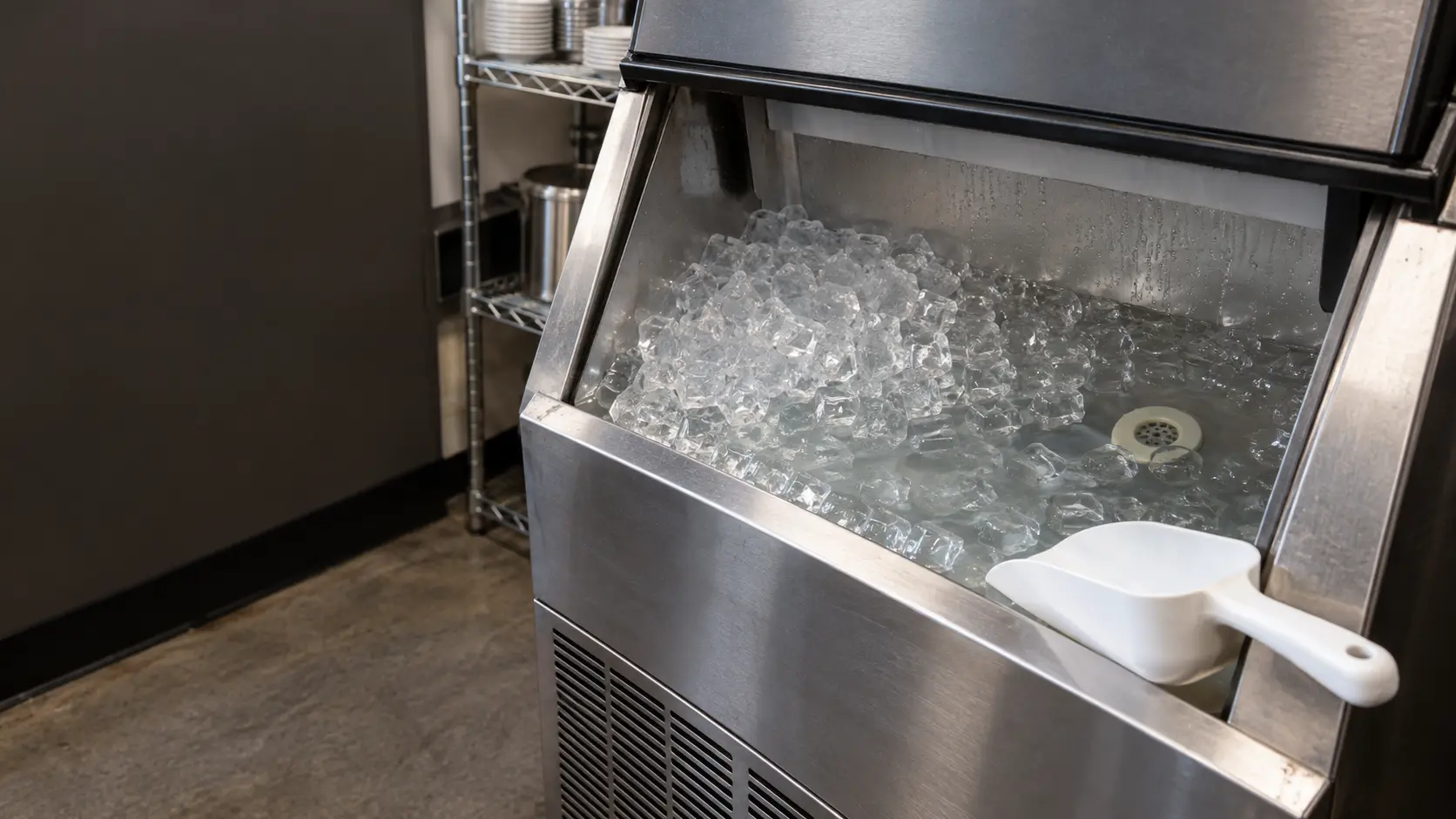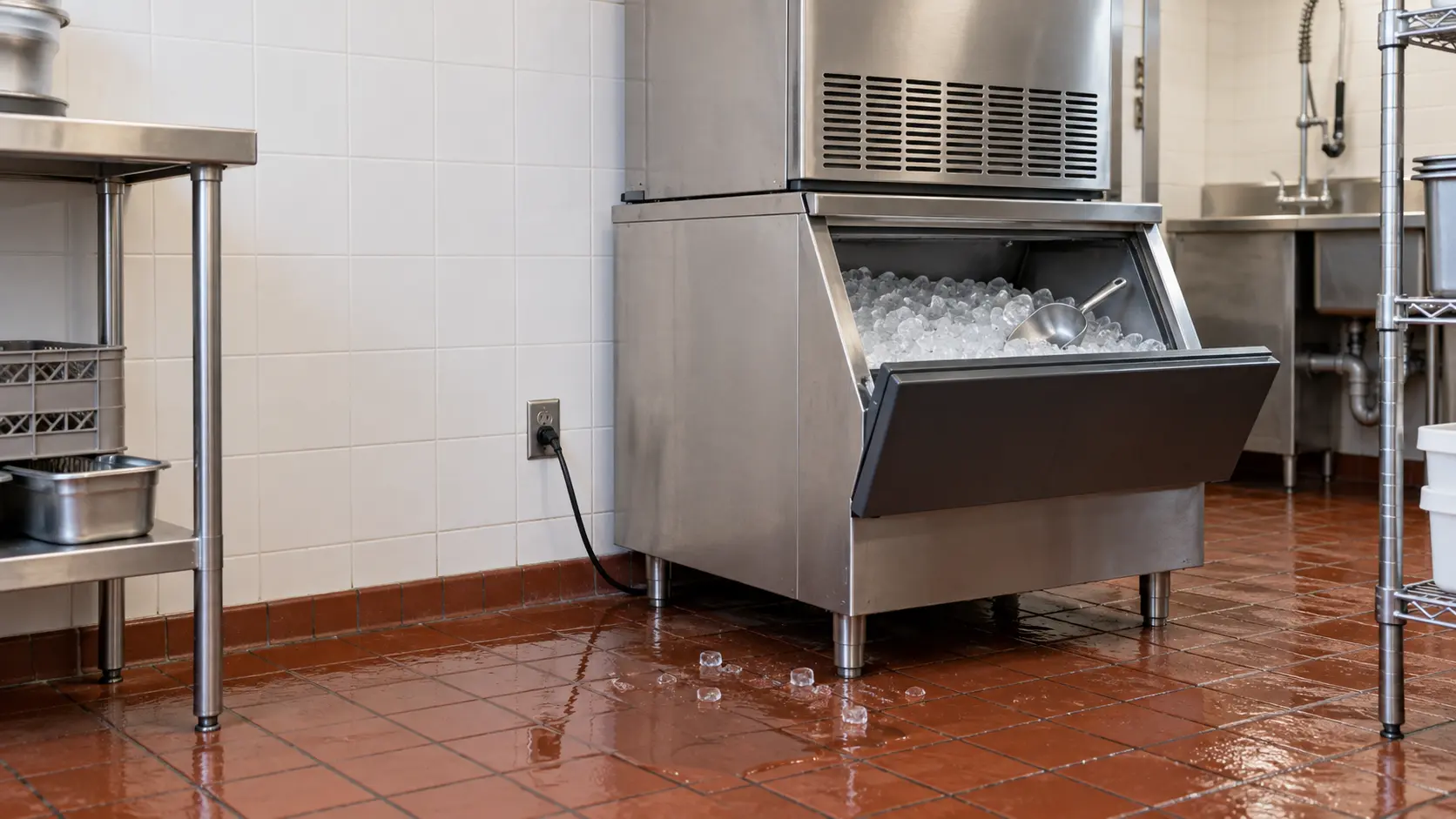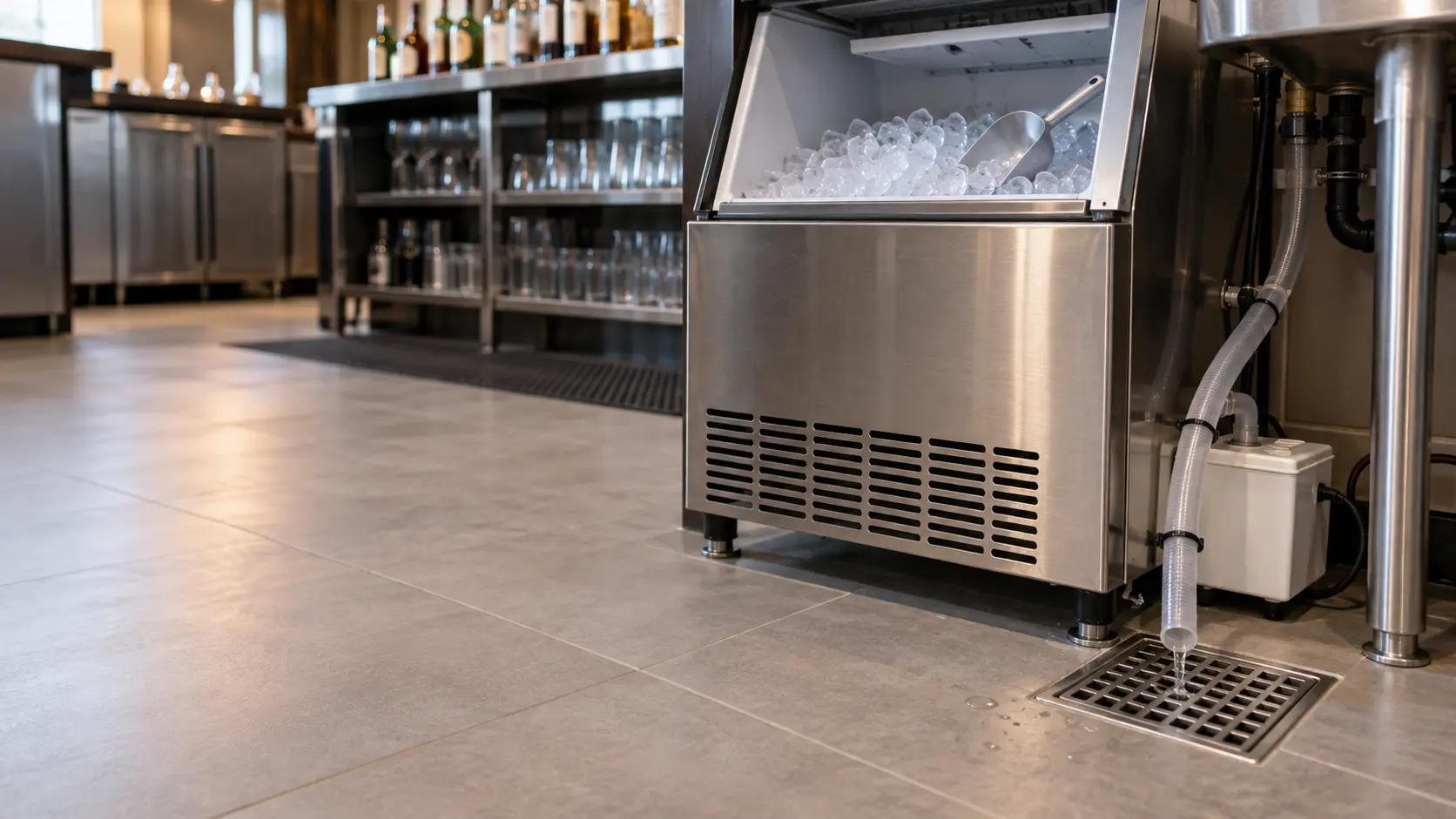
What an air gap is, in plain terms
Picture the drain hose from the ice machine ending a little above a floor sink, with open air between the cut end and the sink's rim. Water falls across that space into the sink. If the building drain ever backs up, the sink fills and overflows onto the floor, but the dirty water has no pipe to climb into the machine and no suction can draw it upward.
The FDA Food Code states the principle for all food equipment: a direct connection may not exist between the sewage system and a drain from equipment in which food is placed. Ice is food under the Code, so the bin and the ice-making section fall under that rule. The Code's annex explains the reason as cross connections, back siphonage and backflow that can contaminate food and food-contact surfaces.
The measure the Food Code uses
Where the Code defines an air gap, for a water outlet above a fixture, it asks for a gap of at least twice the diameter of the pipe and never less than 1 inch. At the drain end, the inspector applies the local plumbing code, which sets the exact distance for the floor sink in your building; the idea is the same, and a drain hose pushed down into the sink below its rim fails it.
Source: FDA — Food Code 2022 (3-202.16, 4-204.17, 5-202.13, 5-402.11 and Annex 3) — No direct connection between the sewage system and drains from food equipment; air gap at least twice the inlet diameter and not less than 1 inch; waste lines may not pass through an ice machine or bin
How an installer runs an ice machine drain
The maker's manual is the installer's script, and the two big manuals we checked agree on the essentials. Manitowoc asks for separate bin and ice machine drain lines, a vent on the machine drain open to the atmosphere, and an air gap where the bin drain ends. Scotsman's undercounter cube models call for rigid tubing from the 3/4-inch drain fitting, a vertical vent tube of about 8 inches at the machine, and a steady downhill run to the building drain.
- Separate lines for the bin drain and the ice machine drain, and on water-cooled models a third for the condenser, which Manitowoc says is not vented.
- A vent on the machine drain; Manitowoc's manual gives 46 cm, about 18 inches.
- A fall of at least 1/4 inch per foot in Scotsman's manual, or 2.5 cm per meter in Manitowoc's, with no traps or dips.
- Insulation on the lines in a humid room, so they do not sweat onto the floor.
- A union or similar fitting so the drain can be disconnected in place for service.
- A floor drain large enough to take every line that empties into it at once.
Where the lines end
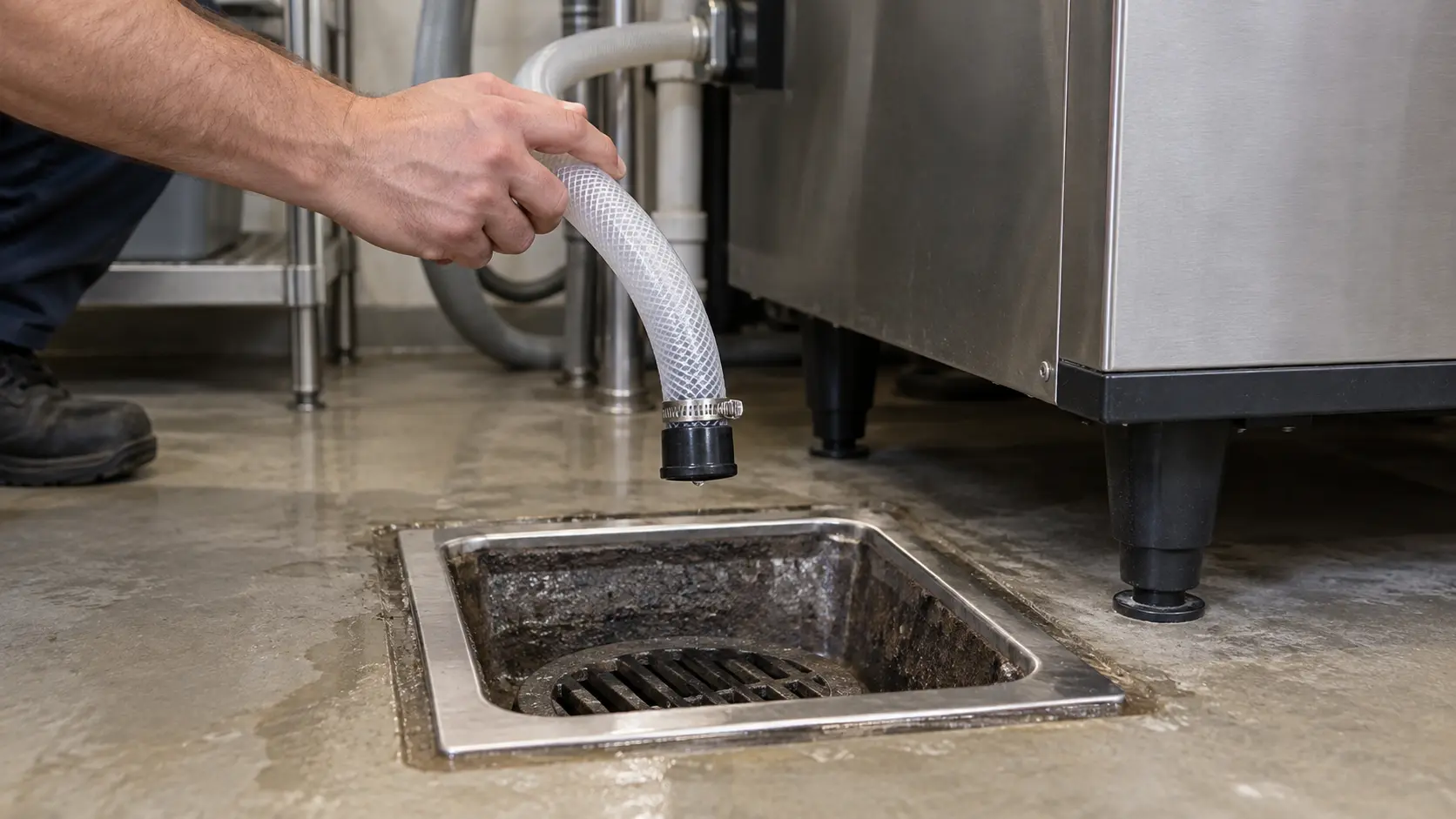
Each line ends above an open floor sink or an approved indirect waste receptacle, cut square and clipped so it cannot drift down below the rim. Scotsman's residential SRC035 manual notes that an air gap is often required by local code between the machine's drain tube and the receptacle, which is why the installer checks with the local inspector before cutting anything.
Source: Manitowoc — Flake and Nugget Ice Machines UFK, UNK, RFK, RNK: Installation, Operation and Maintenance Manual — Separate bin and machine drains; machine drain vented with a 46 cm vent; bin drain ends with an air gap; 2.5 cm per meter drop with no traps; condenser drain not vented; union at drains; backflow preventer where code requires; no hot water; Scotsman — Installation and User's Manual, Cube Ice Machines with Storage CU0415X, CU0715X, CU0920X — 3/4 FPT drain, 8-inch vent tube, 1/4 inch per foot slope, insulate lines; condensate pumps not recommended; built-in air gap at the reservoir; no saddle valves
What happens inside when the drain cannot keep up
A drain that is too flat, kinked or partly blocked does not usually announce itself with a flood. Scotsman describes the first sign: water backs up into the storage bin and melts the ice. Owners see wet, clumped cubes and a bin that never seems full, long before any water reaches the floor.
The Food Code adds a rule about the path itself: liquid waste drain lines may not pass through an ice machine or an ice storage bin. Its annex explains that such lines can leak, can carry condensate down their outside into the ice, and are hard to clean where they enter the cabinet.
Gravity or a drain pump
A gravity drain is the default because it has no moving parts. Where the floor sink sits higher than the machine's outlet, some undercounter models take a pump; Scotsman sells its SRC035 in gravity and pump versions and offers a kit to convert one to the other. For its commercial cube models, Scotsman does not recommend condensate pumps at all because of the potential for leaks.
Source: FDA — Food Code 2022 (3-202.16, 4-204.17, 5-202.13, 5-402.11 and Annex 3) — No direct connection between the sewage system and drains from food equipment; air gap at least twice the inlet diameter and not less than 1 inch; waste lines may not pass through an ice machine or bin; Scotsman — Installation and User's Manual, Residential Ice Machine SRC035 — An air gap is often required by local code at the drain receptacle; drain restrictions back water into the bin; gravity and pump models, with a conversion kit
The water supply has its own protection
Backflow can run the other way as well, from the machine into the drinking water. On Scotsman's undercounter cube models the protection is built in: an air gap between the end of the water inlet hose and the top of the reservoir water, so no separate device is needed there. Manitowoc asks for a backflow preventer on the water inlet wherever local code requires one.
The supply line also needs a shutoff valve and a union at the machine, and Scotsman warns against piercing-type saddle valves, which restrict flow and clog. Manitowoc adds that the ice machine must never be connected to hot water.
Source: Manitowoc — Flake and Nugget Ice Machines UFK, UNK, RFK, RNK: Installation, Operation and Maintenance Manual — Separate bin and machine drains; machine drain vented with a 46 cm vent; bin drain ends with an air gap; 2.5 cm per meter drop with no traps; condenser drain not vented; union at drains; backflow preventer where code requires; no hot water; Scotsman — Installation and User's Manual, Cube Ice Machines with Storage CU0415X, CU0715X, CU0920X — 3/4 FPT drain, 8-inch vent tube, 1/4 inch per foot slope, insulate lines; condensate pumps not recommended; built-in air gap at the reservoir; no saddle valves
What an inspector or a technician looks at
When we are called to a machine with a slow drain or a wet bin, the drain is checked from the fitting on the cabinet to the floor sink, in that order, before any part inside the machine is blamed.
- The drain hose ends above the floor sink rim, not in it, and cannot slide down.
- The machine drain is vented and the bin drain is a separate line.
- The run slopes downhill the whole way, with no sag holding standing water.
- The floor sink itself drains freely and is not shared with a source that floods it.
- Nothing in the drain run passes through or over the ice bin.