
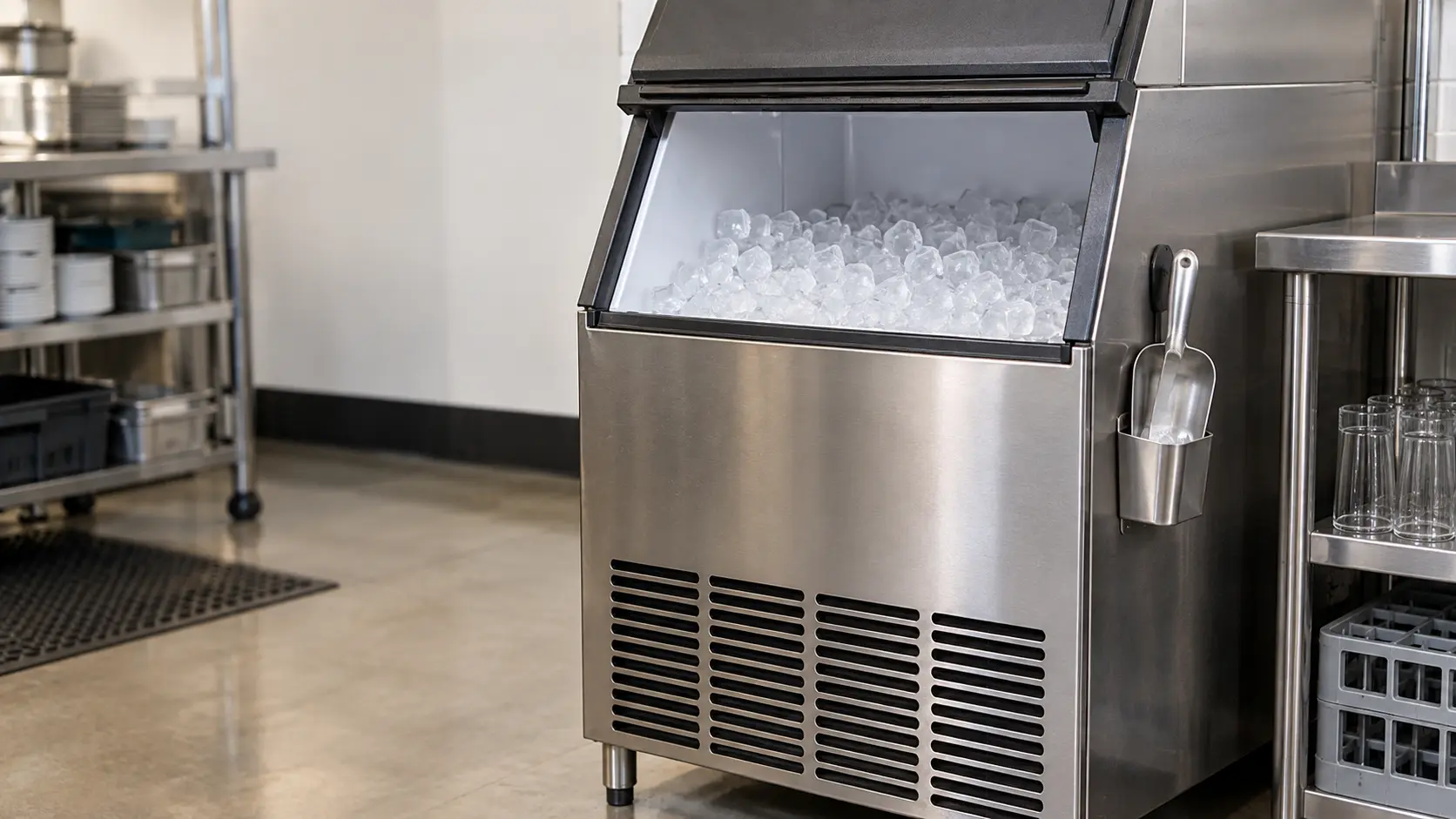

Why newer ice machines carry a flammable gas
Ice machines have moved to low global-warming gases, and for small self-contained units the common choice is propane. EPA's SNAP program lists R-290 as acceptable in new self-contained commercial ice machines subject to use conditions, and its 2024 rule ties those conditions to UL 60335-2-89 and ASHRAE 15, covering testing, charge size, ventilation, the space the machine is used in, and hazard warnings and markings on the unit.
Manitowoc's manual for its flake and nugget machines puts numbers on it: models may hold up to 150 grams of R-290, and propane is flammable in air between roughly 2.1 and 9.5 percent by volume. A charge that small, in a sealed circuit that was built and tested for it, is not a hazard in daily use. It becomes one only when it escapes into a closed space that also holds a spark.
How to tell which gas your machine uses
The nameplate on the back or inside the front panel lists the gas and its charge; Manitowoc tells owners to check it there. Machines on R-290 also carry warning labels about the flammable gas, and Scotsman prints a flame warning at the very front of its manuals. Write the model, serial and gas type on a card now, so nobody has to go looking in an emergency.
Source: EPA — SNAP: Substitutes in Commercial Ice Machines — R-290 is acceptable, subject to use conditions, in self-contained commercial ice machines; EPA — SNAP Final Rule 26 fact sheet (May 2024) — R-290 only in new ice machines designed for it, consistent with ASHRAE 15-2022 and UL 60335-2-89, including charge sizes, ventilation, usage space, hazard warnings and markings; Manitowoc — Flake and Nugget Ice Machines UFK, UNK, RFK, RNK: Installation, Operation and Maintenance Manual — Up to 150 g of R-290; flammable at about 2.1–9.5% in air; check the nameplate; no sharp tools on ice or frost; not in public corridors; only trained technicians and the maker's parts; disconnect power before service
What to do the moment you smell gas or hear a hiss
Treat a gas smell near an ice machine as a gas leak until someone qualified says otherwise. Switches, plugs and phones make small sparks, so the rule is to leave them alone in that room and act from outside it.
- Do not switch lights, fans or the ice machine on or off, and do not unplug anything in the room.
- Put out any flame and stop anyone from smoking or vaping; Scotsman warns against cigarettes, vapes and cellphones near the machine's pipes and cables.
- Open doors and windows on the way out if they are within reach.
- Get everyone out of the room, then out of the building if the smell is strong.
- If the breaker panel is in another room, switch off that circuit there; never go back in to do it.
- Call 911 from outside if the smell is strong, and the gas utility if the building has fuel gas.
Source: Scotsman — Installation and User's Manual, Cube Ice Machines with Storage CU0415X, CU0715X, CU0920X — R-290 flammable warning; no cigarettes, vapes or cellphones near pipes; no open flame, gas appliance or electric heater nearby; no flammable aerosols stored inside; ventilated room; qualified installer; rated recovery containers filled no more than 80%

The smell may not come from the ice machine at all
Fuel gas piped to fryers, ovens and water heaters is odorized so leaks can be smelled. Propane used as a cooling gas is a purified product; when EPA first listed propane for this use in 2011, it said its rule neither required nor prohibited adding an odorant, and that its risk screen had assessed the gas without one. A leak from an ice machine's circuit may therefore give little or no smell.
That cuts both ways. A rotten-egg smell in a bar with gas-fired equipment may be coming from that equipment's supply, not from the ice machine, and it still means leaving the room. A quiet leak from the ice machine, on the other hand, may show only as a hiss or as a machine that has stopped making ice.
Sounds that belong to the cycle
A working machine makes a rhythm of sounds: water running over the evaporator, a fan, a pause, then the rattle of cubes falling into the bin at each harvest. Those repeat and stop. None of them is a continuous hiss from one spot.
Sounds that call for leaving the room
A steady hiss or whistle from inside the cabinet that goes on between cycles, especially after a knock, a move or someone chipping at ice, is the sound to take seriously. Leave, follow the steps above, and describe the sound when you call.
Source: EPA — SNAP Rule 17, Federal Register, December 20, 2011 — EPA's risk screen assessed hydrocarbon refrigerants without an odorant; the rule neither requires nor prohibits adding one
What the makers' warnings ask of owners and staff
The manuals for R-290 ice machines read like a short list of house rules, and most of them are about keeping a spark and a leak apart. They are easy to follow and cost nothing.
House rules for a machine on R-290
- Keep open flames, operating gas appliances and electric heaters away from it, as Scotsman directs.
- Never store aerosol cans with a flammable propellant in the bin.
- Keep the room ventilated and the machine's vents and louvers clear.
- Never chip ice or frost with a knife, pick or other sharp tool; Manitowoc forbids it because it can pierce the circuit.
- Keep gasoline and other flammable vapors or liquids out of the area.
- Do not place the machine in a corridor or hallway of a public building; Manitowoc's manual rules that out.
Who works on the sealed system, and how
Manitowoc allows only technicians with flammable-gas training, who understand high voltage and gas under pressure, to work on these machines, and it asks for replacement parts from the maker's own network. Scotsman says the installation must be carried out by a suitably qualified person, that non-original parts can be dangerous, and that decommissioning needs recovery containers rated for R-290 and filled no more than 80 percent.
On a visit, the technician disconnects power before touching the circuit, checks for leaks with the right equipment, and repairs or recovers the gas using tools rated for it. A machine that lost its charge is not simply topped up: the leak is found and fixed first, or the repair-or-replace decision is made with the owner.
Source: Manitowoc — Flake and Nugget Ice Machines UFK, UNK, RFK, RNK: Installation, Operation and Maintenance Manual — Up to 150 g of R-290; flammable at about 2.1–9.5% in air; check the nameplate; no sharp tools on ice or frost; not in public corridors; only trained technicians and the maker's parts; disconnect power before service; Scotsman — Installation and User's Manual, Cube Ice Machines with Storage CU0415X, CU0715X, CU0920X — R-290 flammable warning; no cigarettes, vapes or cellphones near pipes; no open flame, gas appliance or electric heater nearby; no flammable aerosols stored inside; ventilated room; qualified installer; rated recovery containers filled no more than 80%


