
What the growth looks like, and where it settles first
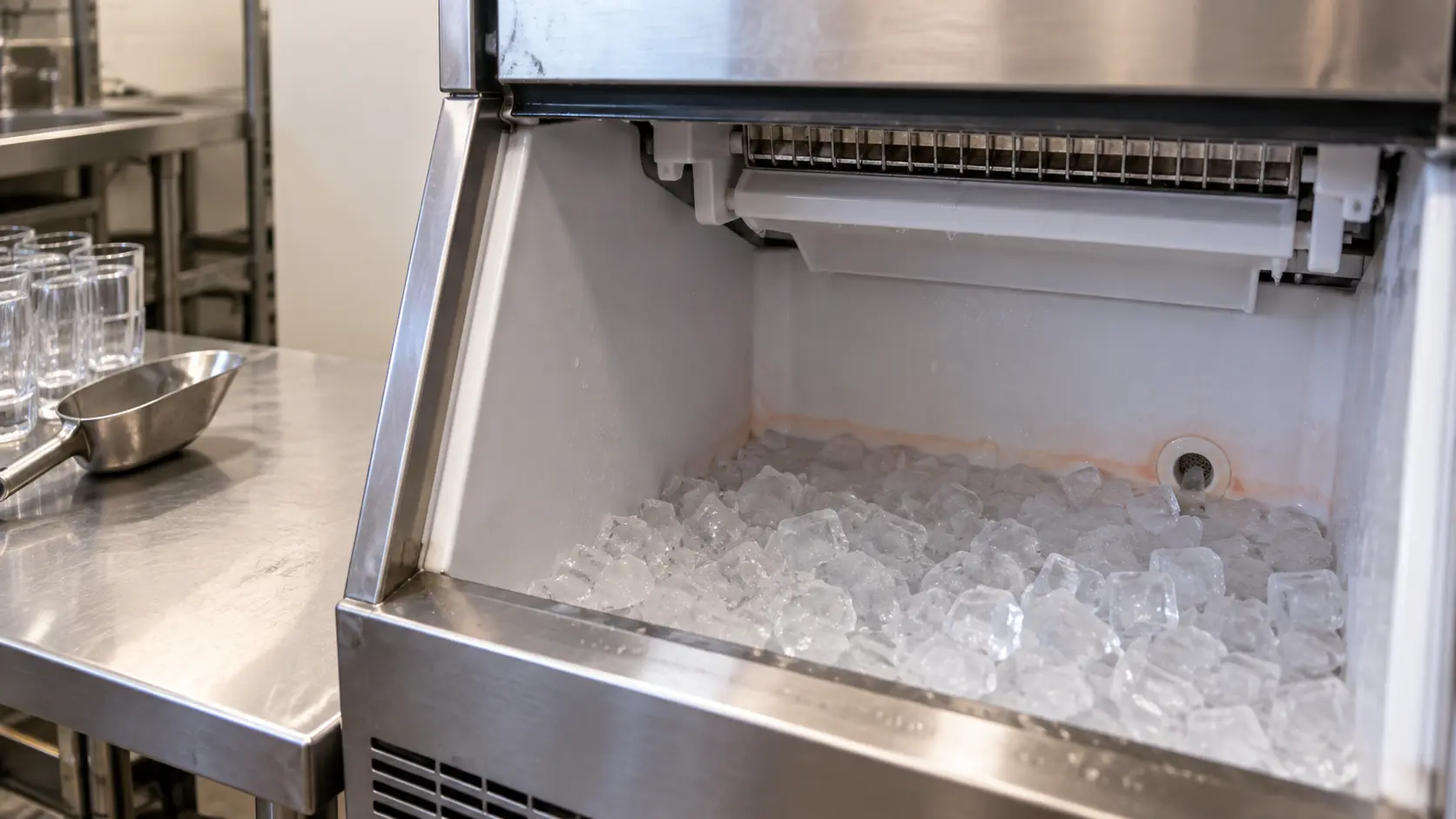
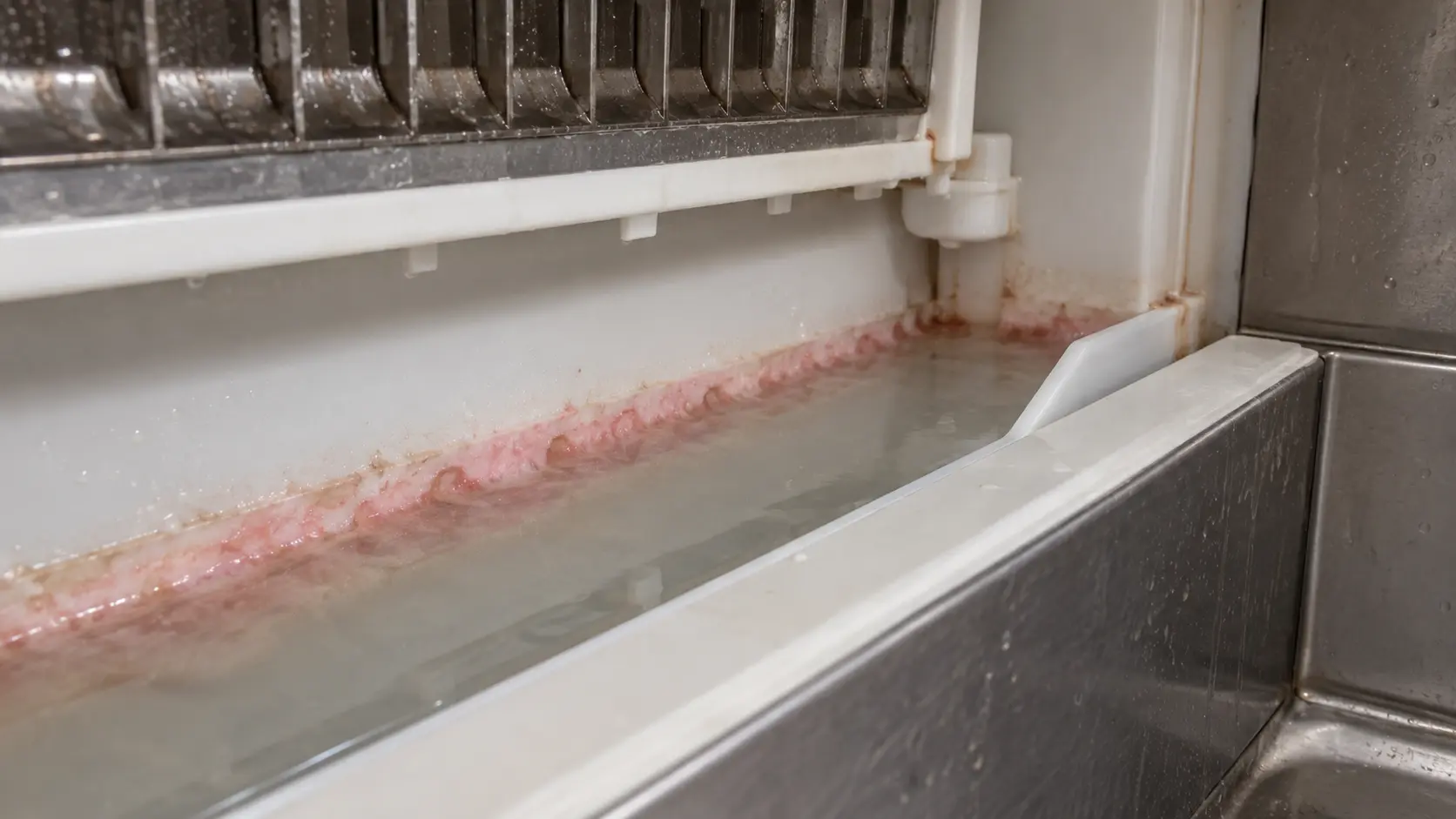
Most of what owners call mold in an ice machine is a mix: a slippery biofilm of bacteria and yeast, sometimes pink or orange, and true mold that shows up as black or green dots. It clings to plastic and stainless surfaces that are wet for hours at a time but never flushed hard, and it spreads in the dim spaces behind panels that nobody opens between service calls.
The cubes themselves usually look clean, which is why the problem is found late. A bartender notices a pink edge on the bin door, or a customer finds a dark fleck in a glass, long after the film has coated the parts the water runs over.
The usual hiding places
- The water curtain or splash shield that hangs in front of the evaporator on a cube machine.
- The ice chute and deflector the cubes slide across on the way into the bin.
- The water trough and the small holes of the distribution tube above the evaporator.
- The inside of the bin door, its gasket and the lip where the door meets the bin.
- On a dispenser, the rotor, the chute cover and the outlet the ice drops through.
Pink, black or clear jelly
Pink and orange films are usually bacteria and yeast that feed on whatever the air brings in. Black or green spots point to mold that has had weeks without a proper clean. A clear, jelly-like coating on the curtain is a biofilm that has not yet picked up color, and it is the easiest of the three to remove if it is caught at that stage.
Why an ice machine grows it in the first place
An air-cooled ice machine pulls room air through its cabinet all day. In a bar that air carries yeast from beer taps and bread, flour dust from a prep table, grease from a fryer and moisture from a dish area. Manitowoc's installation manual says plainly that the location must be free of airborne and other contaminants, because whatever floats past the grille settles on wet surfaces inside.
Warmth helps the growth along. The storage bin is insulated but not chilled, so the air above the ice is cool rather than cold, and the parts above the ice line stay damp between harvests. A machine next to a dishwasher vent or a steam table gives that film a warm, humid place to live.
The air the machine breathes
Moving an ice machine away from the yeast and flour sources, or giving it a filtered air path, often does more for slime than cleaning twice as often. When the growth comes back within weeks of a full sanitize, look at what sits within a few feet of the air intake before blaming the chemicals or the technician.
Source: Manitowoc — Flake and Nugget Ice Machines UFK, UNK, RFK, RNK: Installation, Operation and Maintenance Manual — Location must be free of airborne contaminants; sanitizing may be done more often than descaling; do not mix descaler and sanitizer; using them against their labeling violates federal law
What the FDA Food Code asks of an ice machine
The Food Code treats ice as food: ice served in a drink or used to chill food must be made from drinking water. It then names ice bins and the enclosed parts of ice makers among the equipment that must be cleaned at the frequency the manufacturer specifies, or, where the maker is silent, often enough to prevent soil or mold from building up. Its public-health annex says why: those surfaces grow slime and mold that can carry microorganisms into the ice.
The Code also says to clean at any time when contamination may have occurred. A drain backup into the bin, a dropped glass, or a scoop left lying in the ice are all moments that restart the clock, whatever the calendar says.
- Keep the scoop in a clean holder outside the ice. FDA's inspection guidance makes an exception to handle-up storage in the ice for an ice machine bin.
- Never serve ice that has been used to chill bottles, cans, melons or a cooling coil; the Code forbids it.
- Keep glassware out of the bin. A broken glass means emptying the ice, cleaning and sanitizing before the machine refills.
Source: FDA — Food Code 2022 (3-202.16, 3-303.11, 3-304.12, 4-602.11 and Annex 3) — Ice is made from drinking water; ice bins and ice makers are cleaned at the maker's frequency or often enough to prevent soil or mold, and whenever contamination may have occurred; ice used as an exterior coolant may not be served; scoop storage guidance
Descaling and sanitizing are two different jobs
Scale is the mineral left behind as water freezes, and it gives slime a rough surface to hold on to. The Scotsman manual for its undercounter cube models calls for scale removal at least every six months, followed by a separate sanitizing pass in which the bin, the reservoir and the inside of the door are wiped with the sanitizer solution. Its wall-mount dispensers ask for the bin and rotor to be cleaned at least as often as the ice-making system.
Manitowoc adds that sanitizing can be done on its own, and more often than descaling, when a machine needs it. It also warns that its descaler and sanitizer must never be mixed, and that using them against their label is a violation of federal law. That is why a restaurant should keep the exact products the manual names, and follow the dilution printed on them.
What staff can do between visits
- Wipe the bin door, its gasket and the lip with the sanitizer the manual names, mixed as its label says.
- Empty and wipe the scoop holder every shift.
- Look behind the curtain with a flashlight once a week, without removing panels.
- Write down the date of every clean on a card taped inside the cabinet door.
Source: Manitowoc — Flake and Nugget Ice Machines UFK, UNK, RFK, RNK: Installation, Operation and Maintenance Manual — Location must be free of airborne contaminants; sanitizing may be done more often than descaling; do not mix descaler and sanitizer; using them against their labeling violates federal law; Scotsman — Installation and User's Manual, Cube Ice Machines with Storage CU0415X, CU0715X, CU0920X — Scale removal at least every 6 months, then sanitizing that wipes the bin, reservoir and inside of the door; the bin is insulated but not chilled; Scotsman — Installation and User's Manual, Meridian Ice Maker-Dispensers, wall-mount models — Bin and rotor cleaned at least as often as the ice-making system; minimum six months between cleanings, with a Time To Clean light
Water, filters and guests at higher risk
CDC's Legionella control toolkit lists ice machines among plumbed devices that need attention, and its advice is short: clean regularly and replace filters as the manufacturer recommends. For facilities that serve people at higher risk of Legionnaires' disease, such as hospitals and senior living, CDC suggests considering routine testing of ice machines as part of the water management program.
A filter that has run past its date lets more sediment through and can become a place for growth itself. Mark the change date on the cartridge, and replace it before a full clean rather than after, so that fresh water rinses the sanitized parts.
Source: CDC — Controlling Legionella in Other Devices (Legionella control toolkit) — Clean ice machines regularly and replace filters per the manufacturer; consider routine Legionella testing where people at increased risk are served