People, then power, then water
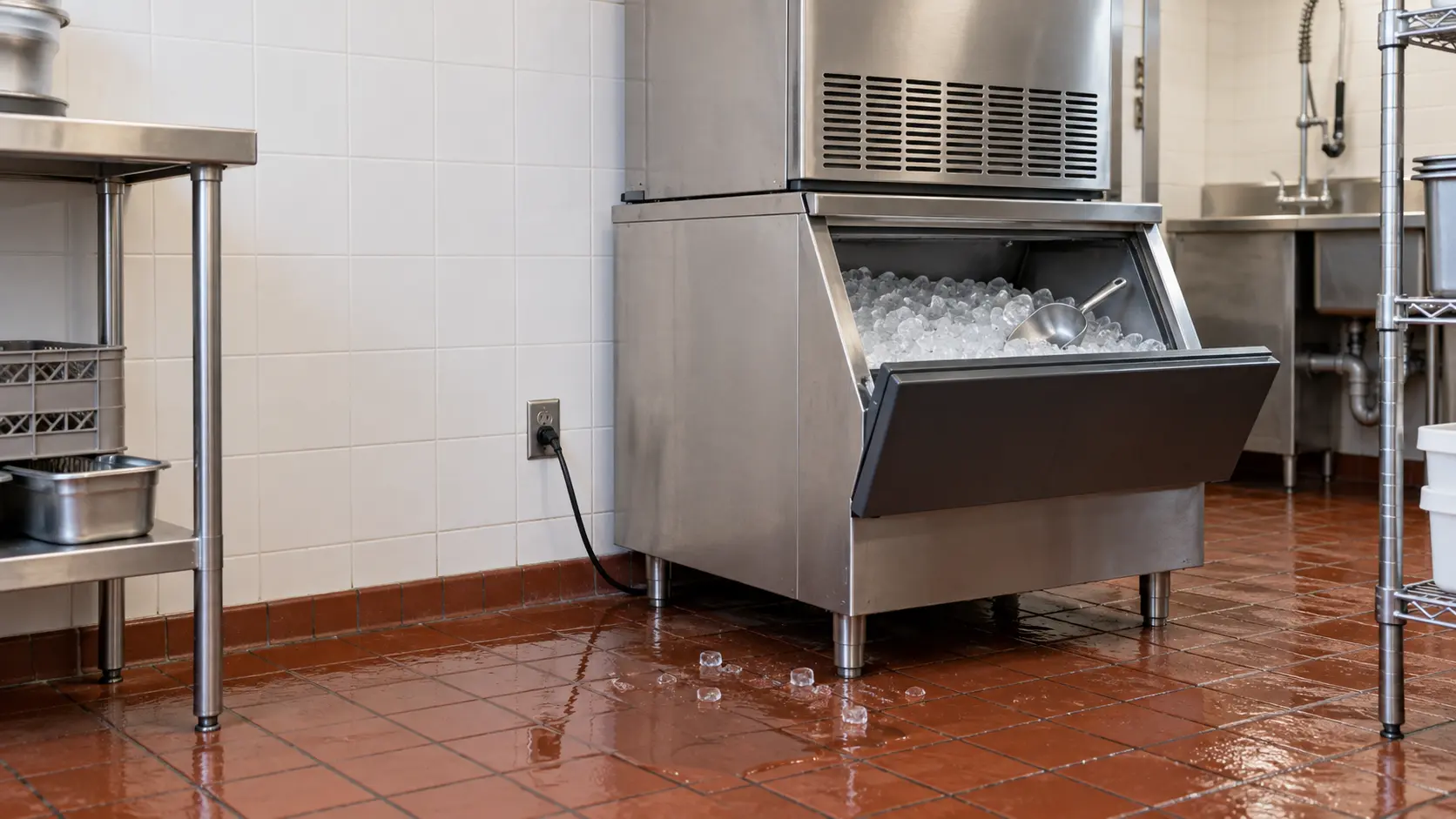
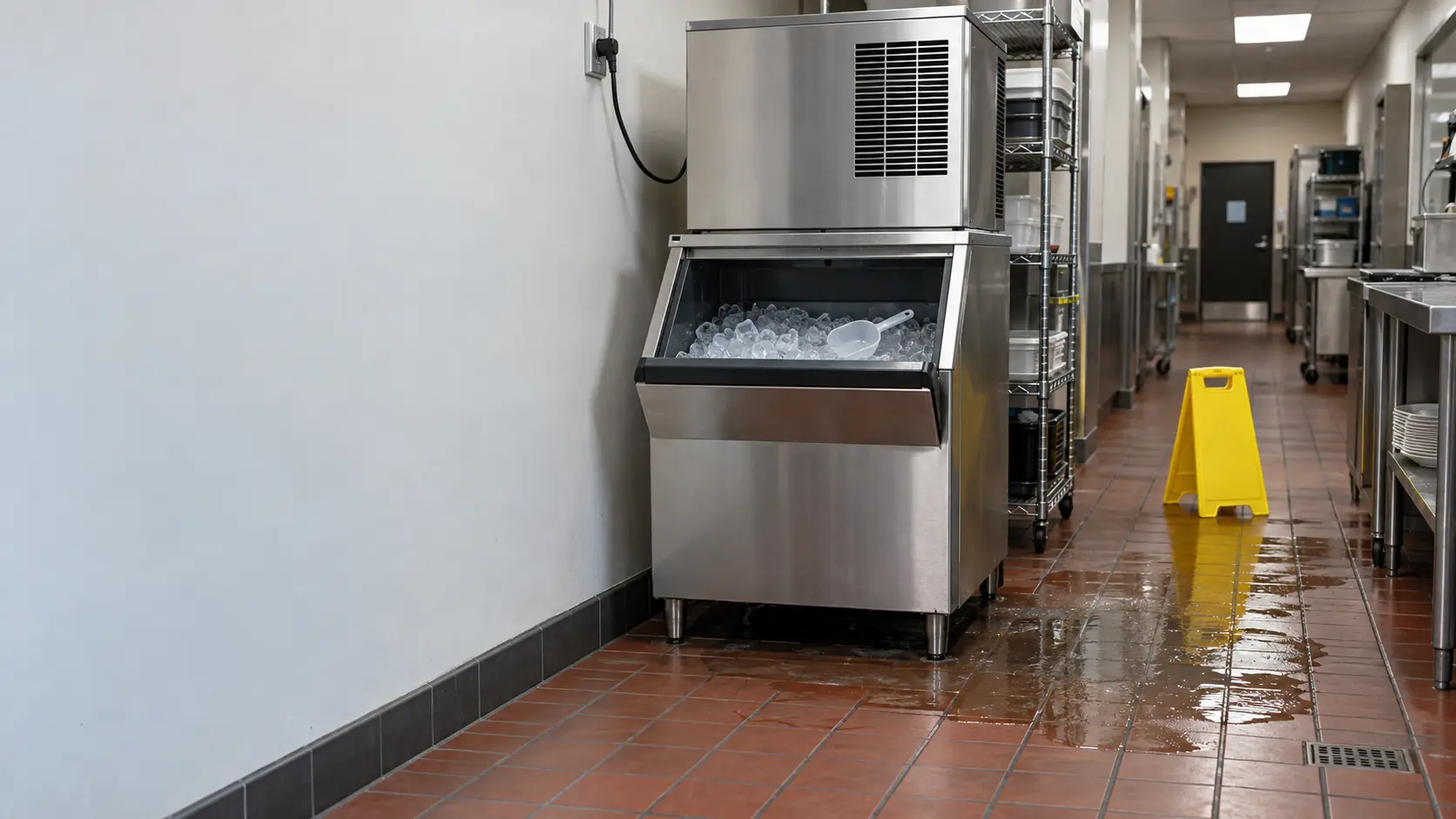
In a bar or a kitchen the water is rarely the expensive part. Somebody walking fast with a full tray, a server in smooth-soled shoes, a guest heading for the restroom: those are the reasons to act before looking for the cause. OSHA's walking-working surfaces rule asks employers to keep each workroom floor clean and, as far as feasible, dry, and to keep walking surfaces free of leaks and spills.
Manitowoc's own manual makes the same point about its machines: moisture collecting on the floor creates a slippery surface and should be cleaned up immediately. With an ice machine leaking on the floor, put a wet-floor sign or a chair across the path first, then deal with the machine.
When water has reached a cord or an outlet
Do not unplug the machine or reach behind it while standing in water. Go to the breaker panel, and switch that circuit off only if the floor at the panel is dry. Manitowoc notes that the power switch on its machines does not disconnect all incoming power, so the rocker on the front is not a substitute for the breaker when water and wiring meet.
Closing the supply valve
Scotsman requires a hand-operated valve within sight of its undercounter cube machines so the unit can be isolated for service, and its residential manual says the shutoff should not sit behind the unit. Turn it clockwise until it stops. If you cannot find one near the machine, the building's main shutoff is the fallback, and the missing valve belongs on the list for the technician.
Source: OSHA — 29 CFR 1910.22, Walking-working surfaces — Workroom floors kept clean and, as far as feasible, dry; walking-working surfaces kept free of leaks and spills; Manitowoc — Flake and Nugget Ice Machines UFK, UNK, RFK, RNK: Installation, Operation and Maintenance Manual — Moisture on the floor creates a slip hazard and should be cleaned up immediately; the power switch does not disconnect all incoming power
Where ice machine water usually comes from
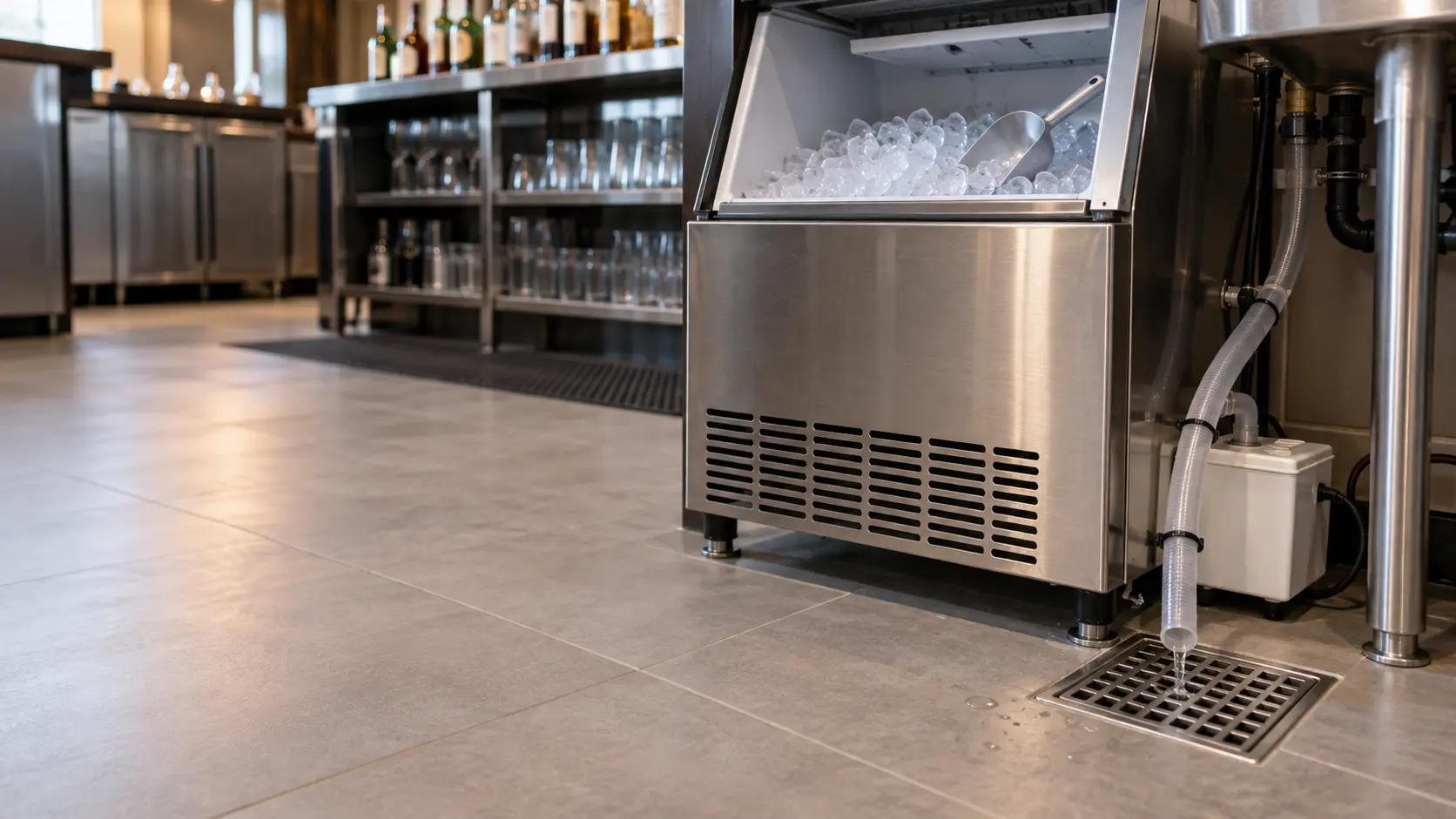
An ice machine handles water in three ways: it takes it in through a supply line, it sends rinse and melt water out through one or more drains, and it sweats wherever a cold surface meets warm air. A leak almost always belongs to one of the three, and the time it appears narrows down which.
- Drain side: a floor sink or floor drain that has slowed, a kinked or sagging drain hose, a bin drain clogged with scale or debris, a drain pump that has stopped.
- Supply side: the inlet fitting at the back, a filter housing that was not seated after a cartridge change, a cracked supply tube.
- Melt and sweat: ice melting faster than the bin drain can take it away, and drain lines without insulation dripping condensation in a humid room.
- The bin door: a warped door or worn gasket letting melt water run out the front instead of down the drain.

Reading the puddle before anyone mops it
Take a photo of the water and note where its edge was before it is wiped up. A pool that starts at the back and runs forward points to a supply fitting or the drain connection. A line of drips from under the bin door points to the door or to a bin that is filling with water because its drain cannot keep up.
Timing is the other clue. Water that appears in a rush every few minutes follows the harvest, when the machine dumps its trough; water that seeps steadily even with the machine switched off comes from the pressurized supply side.
Questions to write down for the technician
- Did the water appear in bursts or as a steady seep?
- Was the floor sink or floor drain beside the machine full or overflowing?
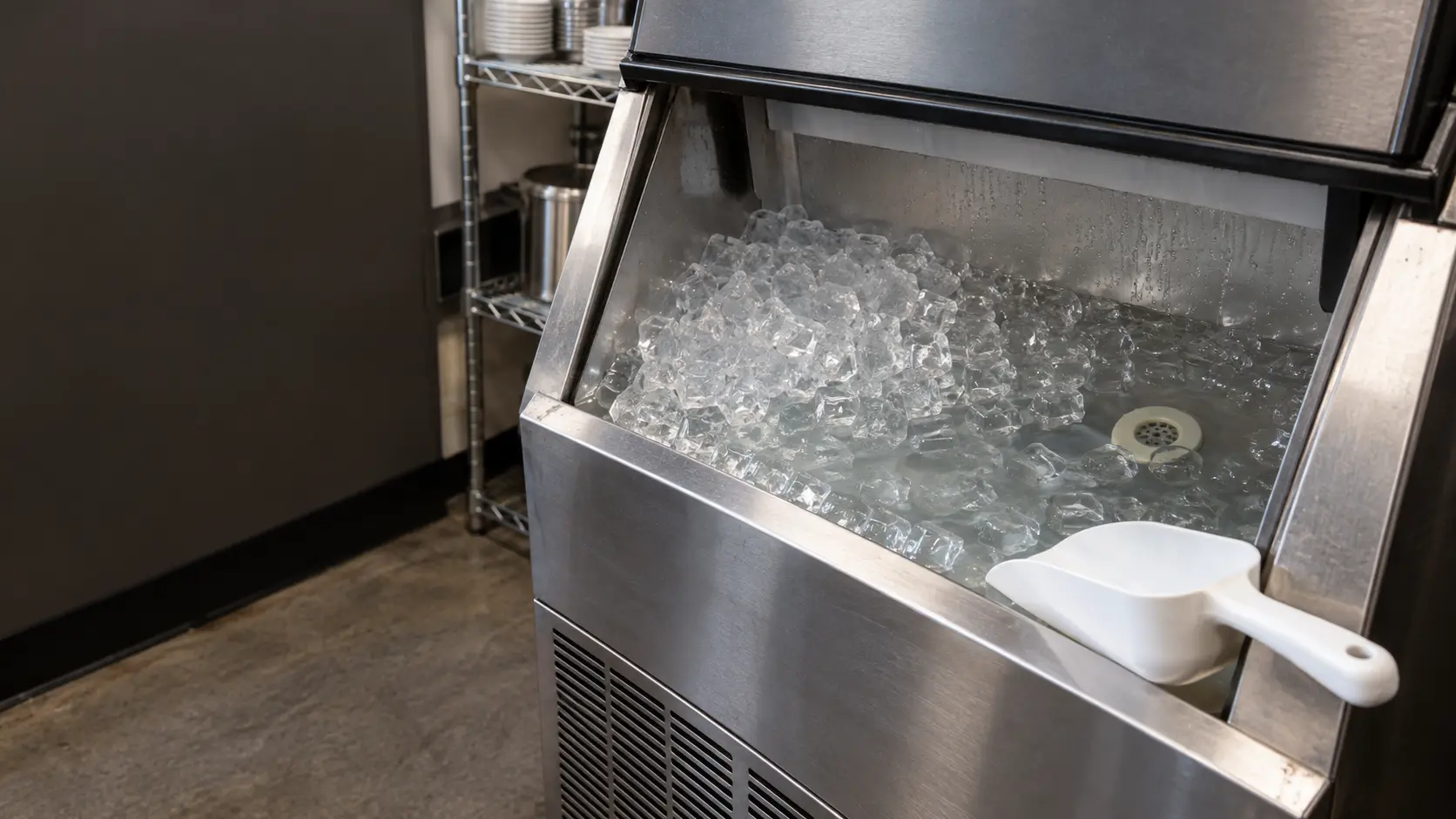
- Was there standing water in the bin under the ice?
- Was a filter changed, or the machine moved, in the last week?
Gravity drains, pumped drains and why makers are cautious
Most commercial ice machines drain by gravity into a floor sink. Where there is no drain low enough, some undercounter models take a drain pump; Scotsman offers a pump kit for its residential SRC035 and warns that any restriction in the drain system backs water into the storage bin and melts the ice. A pump that stops or a check valve that sticks gives the same result, only faster.
For its commercial undercounter cube models Scotsman states that condensate pumps are not recommended because of the potential for leaks, and it asks for the drain tubing to be insulated in humid rooms to limit condensation. A machine that has always run on a borrowed pump deserves a look at whether a gravity route was ever possible.
Source: Scotsman — Installation and User's Manual, Cube Ice Machines with Storage CU0415X, CU0715X, CU0920X — A hand valve within sight of the machine is required; condensate pumps are not recommended because of leaks; insulate drain tubing in humid rooms; Scotsman — Installation and User's Manual, Residential Ice Machine SRC035 — Shutoff valve should not be installed behind the unit; drain pump kit available; drain restrictions back water into the bin and melt the ice
Before the ice machine goes back into service
If drain water reached the bin, or the floor water touched the ice, the ice is no longer food. The FDA Food Code asks for equipment to be cleaned whenever contamination may have occurred, so empty the bin, and plan a clean and sanitize with the products the manual names before the machine fills it again.
Leave the supply closed until the source is known. Restoring the water to a cracked fitting or a blocked drain turns a mopped floor back into a wet one within one harvest.
Source: FDA — Food Code 2022 (4-602.11, 5-402.11) — Ice bins and ice makers are cleaned whenever contamination may have occurred; no direct connection between equipment drains and the sewage system