
What less ice actually means on a cuber
A cube ice machine works in batches. Water runs over a chilled evaporator plate until a sheet of cubes is thick enough, the plate is warmed, the sheet drops into the bin, and the next freeze begins. Daily output is the weight of one batch multiplied by how many batches fit into twenty-four hours, so anything that lengthens a freeze or a harvest quietly removes batches from the day. An ice machine making less ice has almost always lost batches rather than lost the ability to freeze.
That is why a machine can look perfectly healthy and still come up short. Scotsman publishes cycle times for its modular cubers at two conditions, 70°F air with 50°F water and 90°F air with 70°F water, and the second set is always longer. Nothing is broken in the hotter case; there are just fewer drops before the dinner rush.
A low bin is not always low production
Before blaming the ice machine, compare what it makes with what is being taken. Demand creeps too: a new blended cocktail list, a second catering tray each afternoon or a staff room that discovered the bin will empty it faster than the head refills it, with no change in the machine. A residential undercounter unit is slower still: Scotsman says its SRC065 needs 8 to 10 hours of continuous running to fill its bin from empty.
Source: Scotsman — C1448 and C1848 modular cuber installation and user's manual — Cycle times listed at 70°F air / 50°F water and 90°F air / 70°F water; 6 inches at the sides and back, one foot behind and two feet above for rated capacity; do not run without the air filter
Heat around the machine and the condenser
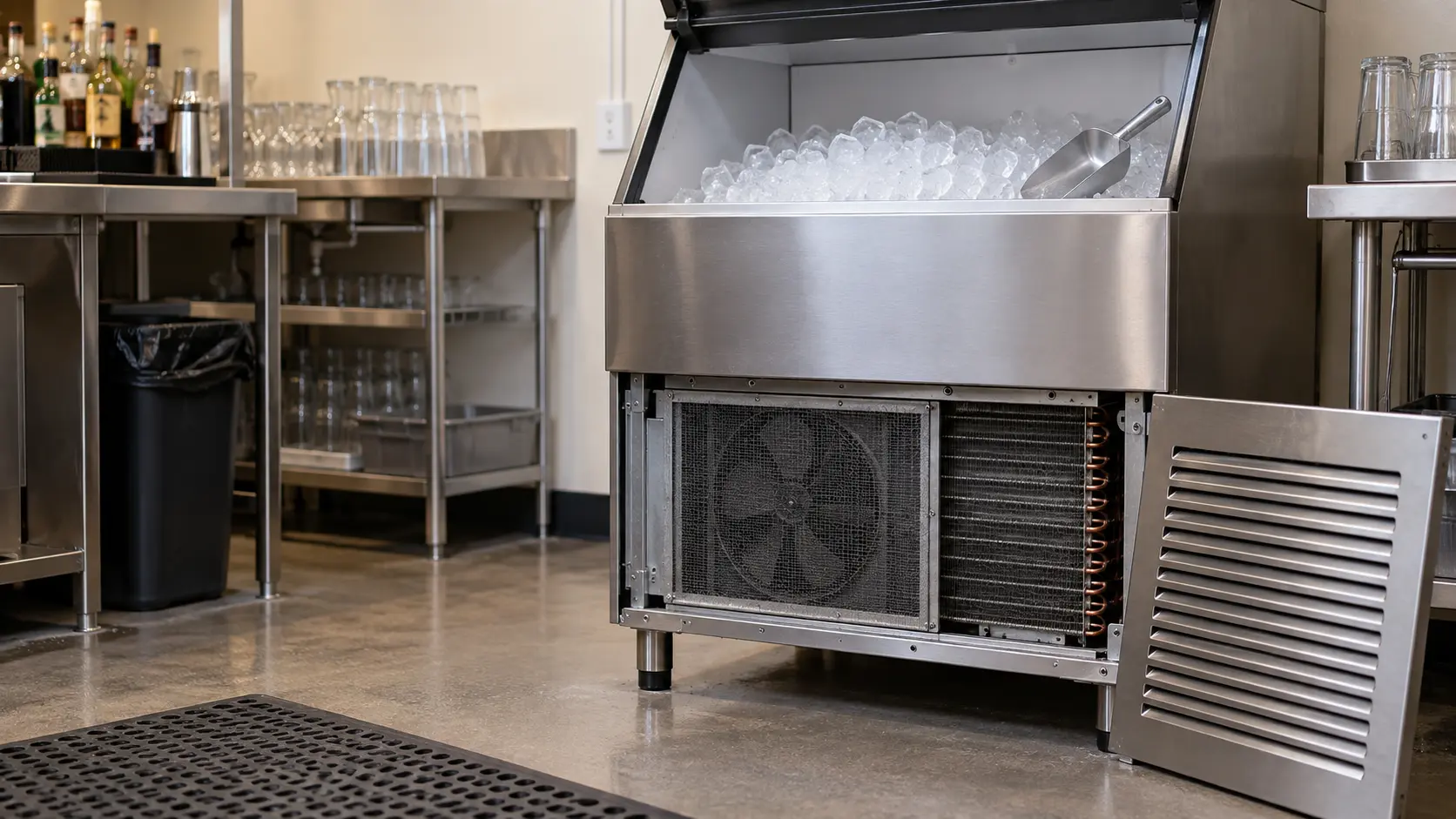
An air-cooled ice machine dumps the heat it pulls out of the water into the room through its condenser. When the air going in is hot, or cannot get in at all, the cooling system has to work harder to reach the same plate temperature, and every freeze stretches. Manitowoc lists 35°F to 110°F as the air limits for its Indigo NXT head sections; Scotsman's self-contained Prodigy cubers are rated 50°F to 100°F, and the manual warns that capacity drops severely above about 95°F.
Clearance matters as much as temperature. Scotsman's modular manual asks for 6 inches at the sides and back just to run properly, and one foot behind with two feet above to make rated capacity. A machine that was slid tight against a wall during a remodel, or that now shares an alcove with a fryer's exhaust, can lose output without a single part changing.
- Feel the air leaving the machine: very hot discharge air in a hot room means the condenser is struggling.
- Look for boxes, bags or a new appliance within a foot of the intake or the exhaust grille.
- Note the room temperature at the busiest hour, not first thing in the morning.
- On a water-cooled unit, check that the condenser water supply is on; a closed valve there cuts output fast.
The washable air filter
Most self-contained ice machines have a washable filter in front of the condenser that catches lint, dust and kitchen grease. Manitowoc asks for it to be washed once a month with mild soap and water, with the power disconnected at the service switch first, and warns that the condenser fins behind it are sharp. Scotsman adds that the machine should never run without the filter in place except during cleaning, because the fins then load up directly.
The condenser coil itself
Manitowoc calls for the condenser to be cleaned at least every six months and suggests shining a flashlight through the fins to see dirt between them. If light does not pass or the dirt stays after the maker's own method, the manual sends you to a service agent. Grease-bonded dust on a coil behind a busy line is the usual reason, and it is a visit rather than a scrub with a wire brush.
Source: Manitowoc — Indigo NXT ice machines, installation, operation and maintenance manual — Head section air limits 35°F to 110°F; wash the air filter monthly and clean the condenser at least every six months with power disconnected; water pressure 20 to 80 psi; low capacity from a dirty inlet screen, closed supply valve, dirty condenser or high air temperature; clean and sanitize at least every six months; 35-minute freeze safety limit; Scotsman — C1448 and C1848 modular cuber installation and user's manual — Cycle times listed at 70°F air / 50°F water and 90°F air / 70°F water; 6 inches at the sides and back, one foot behind and two feet above for rated capacity; do not run without the air filter; Scotsman — CU1526, CU2026, CU3030 self-contained Prodigy cuber manual — Air 50°F to 100°F; capacity severely reduced for air-cooled machines above about 95°F

Water that arrives slowly or not at all
Every cycle begins with the trough filling. If the supply is weak, the machine waits, fills short or makes thin batches. Both Manitowoc and Scotsman expect 20 to 80 psi at the ice-making inlet, and Manitowoc lists a dirty screen in the water inlet valve and a supply valve that has been shut off among the causes of low capacity.
A water filter cartridge that is overdue does the same job as a half-closed valve. The flow drops gradually as the cartridge loads, which matches the slow slide in output most owners describe. If a filter change is due, that is the cheapest first move there is.
- The shutoff valve feeding the ice machine fully open.
- Filter cartridge date checked against the filter maker's interval, and the pressure gauge on the filter head read if there is one.
- No kink in the supply line where it runs behind the bin or under a counter.
- If the trough keeps filling while the head is switched off, the inlet valve is sticking or leaking, and that is a booking.
Source: Manitowoc — Indigo NXT ice machines, installation, operation and maintenance manual — Head section air limits 35°F to 110°F; wash the air filter monthly and clean the condenser at least every six months with power disconnected; water pressure 20 to 80 psi; low capacity from a dirty inlet screen, closed supply valve, dirty condenser or high air temperature; clean and sanitize at least every six months; 35-minute freeze safety limit
Scale and a slow harvest
Mineral scale on the evaporator acts like a layer of insulation and like glue at the same time. The water takes longer to freeze, and the finished sheet clings to the plate during harvest, so the machine spends minutes warming a plate that should release in seconds. Manitowoc lists a dirty ice machine first among the reasons ice is slow to harvest.
The fix for that is the cleaning and sanitizing routine in the maker's manual, done using the cleaner the maker approves and at the interval it sets. Manitowoc sets a minimum of every six months and says that if the machine needs it more often, a service company should test the water and recommend treatment. Scale that has been left for years is a different job: parts come out, and that belongs on a service visit.
Source: Manitowoc — Indigo NXT ice machines, installation, operation and maintenance manual — Head section air limits 35°F to 110°F; wash the air filter monthly and clean the condenser at least every six months with power disconnected; water pressure 20 to 80 psi; low capacity from a dirty inlet screen, closed supply valve, dirty condenser or high air temperature; clean and sanitize at least every six months; 35-minute freeze safety limit
When the drop in output is a component
Some patterns do not come from dust or water. A machine that stops by itself and restarts only after the power button is pressed is using its own safety limits: Manitowoc's control ends a freeze that reaches 35 minutes and stops the machine after six in a row. A harvest that never finishes, a condenser fan that keeps running when it should cycle, or a cabinet that stays hot with a clean coil all point to parts inside the cooling system or its controls.
Machines that run on R-290
Many current ice machines use R-290, which is propane. Scotsman's residential manual warns that the refrigerant is flammable and that only technicians qualified on R-290 should work on the circuit. An owner's checks stop at the filter, the room and the water valve; nothing about low output is ever a reason to open a panel over live wiring or touch a refrigerant line.
Source: Manitowoc — Indigo NXT ice machines, installation, operation and maintenance manual — Head section air limits 35°F to 110°F; wash the air filter monthly and clean the condenser at least every six months with power disconnected; water pressure 20 to 80 psi; low capacity from a dirty inlet screen, closed supply valve, dirty condenser or high air temperature; clean and sanitize at least every six months; 35-minute freeze safety limit


