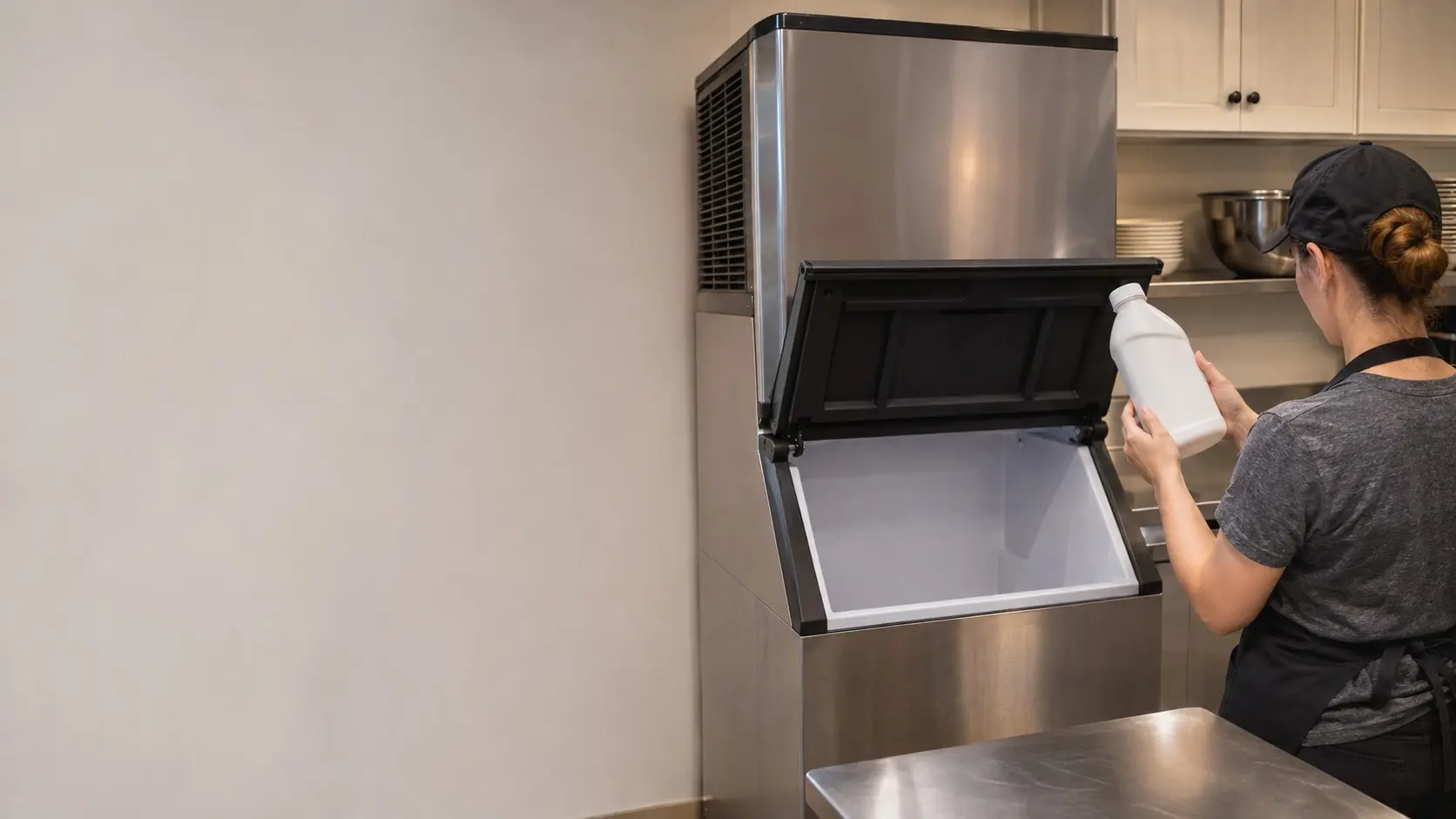


Why does the type of ice machine cleaner matter?
The type matters because the evaporator is plated, and the wrong acid can eat the plating. Scale remover works by dissolving mineral deposit; a formula strong enough to do that on bare metal can also attack a thin nickel coating, leaving dull, rough patches that ice then grips.
Most commercial ice machine makers publish which cleaner their machines accept, and many call for a nickel-safe descaler on their plated evaporators. Others, with different construction, accept standard products. That is why the owner's manual for many models names the cleaner, and why a bottle that worked in the last kitchen may not be right for this one.
What the cleaner is actually for
Cleaner dissolves scale and removes film from the water path. It does not kill germs on its own. Treat it as step one of two, and see below for step two.
How do you tell which cleaner your machine needs?
Start with paperwork. The manual and the data plate settle most cases; the look of the evaporator is a hint, not an answer.
- Find the model name on the data plate; our guide on finding the model and serial shows where it sits on common machines.
- Open the manual to the maintenance chapter and read which cleaner and sanitizer it names.
- If you have no manual, get the maintenance section for your model number from the maker's support line or a technician; the finish of the plate alone can mislead.
- If you still cannot confirm it, treat the machine as plated and choose a nickel-safe product, or ask before you pour.
Signs the wrong one was used
- The plate looks mottled, cloudy or flaking where it used to be smooth.
- Ice sticks more than before and harvest slows, a pattern that can end as a frozen slab.
- A metallic taste appears, or the ice is cloudy in a new way.
A plate in that condition is a repair question, not a cleaning one.

Is a nickel-safe cleaner the same as a sanitizer?
No. Cleaner and sanitizer do different work and go on in a set order. A nickel-safe descaler dissolves scale; a sanitizer, applied afterwards, reduces germs on surfaces that are already clean. Neither does the other's job.
| Cleaner (descaler) | Sanitizer | |
|---|---|---|
| Job | Removes scale and mineral film | Reduces germs on a clean surface |
| Goes on | First | After cleaning and rinsing |
| Plating risk | Yes, if the type is wrong | Low, but follow the label |
| Residue | Must be rinsed out | Follow the product's rinse rule |
The FDA Food Code treats it the same way: food may only touch equipment surfaces that are cleaned and sanitized. For ice makers and ice bins, the Code asks for cleaning at the frequency the manufacturer specifies or, without one, often enough to prevent a buildup of soil or mold. The full routine is in cleaning and sanitizing an ice machine.
Source: FDA Food Code 2026 — section 3-304.11 lets food touch only equipment that is cleaned and sanitized; section 4-602.11(E)(4) sets ice maker and bin cleaning at the maker's frequency or as needed to prevent soil and mold
What goes wrong when it is used incorrectly?
A few mistakes cause most of the harm, and none needs special skill to avoid.
Wrong product
A standard acid cleaner on a nickel-plated plate is the classic error. Another is using a household product such as vinegar or a bathroom descaler where the manual names a specific one.
Wrong amount or order
- Pouring more than the label says does not clean better, and leaves residue in the ice.
- Skipping the rinse means a chemical taste in the first batches.
- Sanitizing over a dirty surface wastes the sanitizer, because soil protects germs.
Mixing
Never mix cleaners with each other or with bleach. Fumes from mixed chemicals can injure staff. Use one product at a time, with the machine's clean cycle, and ventilate the room.
Ice in the bin
Remove all ice before cleaning, and throw away the first batch afterwards. It is not worth gambling on.
What should be on the label before you buy?
The label should say what the product is for, what it is safe on and how to rinse it. Ice machine cleaners are sold for this single job, and the wording is usually plain.
Read these lines
- "Nickel-safe" or a statement that it is safe for plated evaporators, if your plate needs it.
- A line saying it is for ice machines and that the ice-contact surfaces must be rinsed.
- A dilution rate and a contact time, so you do not guess.
- A note on whether it is a cleaner, a sanitizer, or both in separate bottles.
Check the supplier too
Buy the product the manual names, or one whose label states that it is made for your machine type. If the label and the manual disagree, the manual wins; ask the maker's support line or a technician before using it. A bottle bought for a different machine is the usual route to a wrecked plate.
How often should you clean, and when should you get help?
Clean at the interval your manual gives; busy or hard-water sites often need to clean more often than a quiet one. A water filter slows scale but does not remove it, so see scale and the water filter.
If the ice tastes or smells odd, begin with why the ice tastes or smells off before you pour more chemical. A clean that cannot be finished, or a bin lining with slime that returns within days, is a job for the cleaning and sanitizing service. Slime is covered in slime and mold in the bin.
Keeping a record
Write the date, the product and the person who did it on a card near the machine. The record shows whether the interval is holding and spares the next person from guessing which bottle was used last.


