
What does a frozen-up ice machine actually mean?
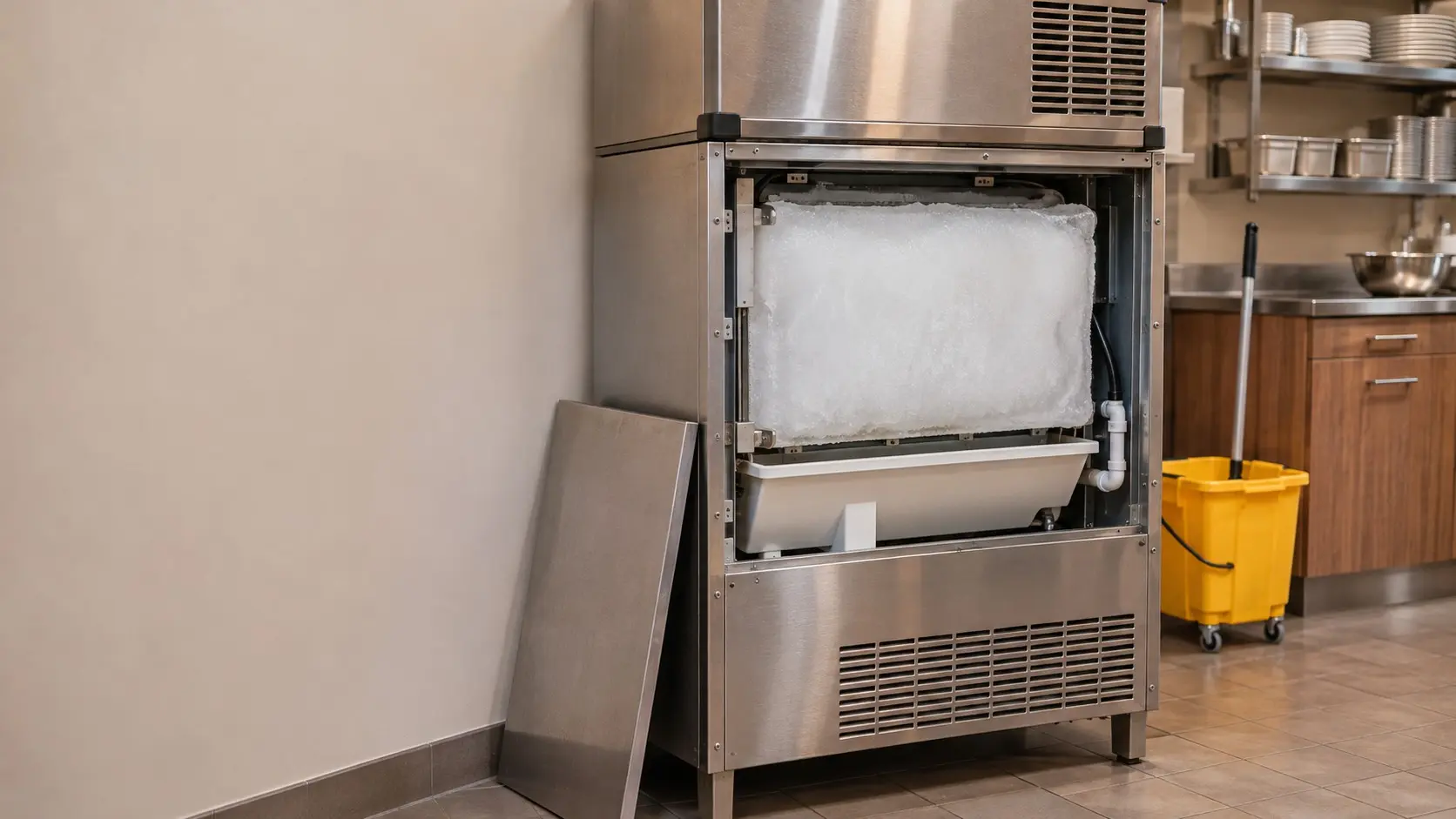
A frozen-up ice machine has built ice faster than it can release it, so the cubes bridge together and form one slab across the evaporator. In a normal cycle the machine freezes ice for a set time, then warms the plate briefly so the sheet slides into the bin. Freezing up means that warm-up, or the sensing that triggers it, did not do its job.
The slab tells you something. A slab that is thick at the top and thin at the bottom points to water that ran short. A slab that is thick everywhere and glassy points to a harvest that never happened. A slab with a rough, white, cloudy texture often points to scale or a weak water supply.
Why it gets worse by itself
Once ice covers the plate, the machine cannot warm it enough to release anything, and the next freeze lays more on top. Left running, the pile can press on the water distribution tube and the curtain. That is why a machine that was merely slow on Monday can be a solid block by Wednesday.
What usually causes the slab?
Four causes account for most freeze-ups, and they are cheap to sort by what you can see.
- Scale on the plate. Mineral deposit makes ice grip the metal. The cubes stay put during harvest, so the next freeze fuses them. See how it builds in scale and the water filter.
- Low or interrupted water. A closed hand valve, a clogged inlet screen, a weak supply or a tired inlet valve means too little water reaches the plate, and thin cubes freeze solid onto it. A failing water valve or filter is a common culprit.
- A thickness probe that reads wrong. Many cube machines end the freeze when the ice bridges a probe. A coating of scale or slime on the probe can make it ignore the bridge, so the freeze runs on.
- A harvest that does not fire. A weak harvest valve, a gas-assist problem or a control that never calls for it leaves the plate cold. This is a job for harvest repair.
What a hot room does
A hot room or a clogged condenser does not usually cause a slab by itself, but it lengthens every freeze and weakens harvest, which tips a marginal machine over. Cleaning the condenser is part of keeping the condenser clean.

How do you thaw it safely?
The safe way to thaw a frozen machine is to switch it off at its own switch, shut the water supply and let the slab melt on its own. It is slow, and that is the point: the evaporator is a thin plate that can be dented or cracked by anything forceful.
What must never be used
- Knives, screwdrivers, ice picks or any other tool to chip or pry the slab.
- Boiling water or a heat gun on the plate. Sudden heat can distort it, and water can reach parts that should stay dry.
- A hair dryer held close to wiring, the control board or the water pump.
Warm bin water is not a thaw tool either. Let the slab drop on its own, then wipe up what lands in the bin.
Things to do while it melts
Put towels or a pan under the machine if the bin drain is slow. Take a photo of the slab before it melts, and note which side was thickest. Throw away every cube that came out of the frozen machine and any ice in the bin that touched melt water, then clean the bin before restarting. How to do that properly is in cleaning and sanitizing an ice machine.
What can you check before you restart it?
You can rule out the simple causes in about ten minutes, with the machine off and the slab gone.
| Check | What good looks like | What it points to if not |
|---|---|---|
| Hand valve on the supply | Fully open, handle in line with the pipe | Water ran short |
| Inlet screen at the water valve | Clean mesh, no grit | Weak fill, thin ice |
| Water in the sump | Fills to the level your manual shows | Valve or float problem |
| Plate surface | Smooth, shiny metal | Scale, a descale is due |
| Thickness probe | Clean, straight, in its holder | Dirty or bent probe |
| Curtain and bin | Curtain swings freely, bin not jammed | Ice not clearing |
If the plate is scaled and your manual calls for a descaling, use the cleaner your manual names for your plate material, and rinse well. A bad choice of cleaner is its own problem, so read the label against the manual before you pour. Cleaner and sanitizer are two separate steps.
Restarting
Turn the water on, power the machine on and watch the first full cycle. If it freezes, warms and drops a sheet, the cause was probably scale or water. If it begins to freeze solid again, switch off and stop there.
When is it more than a cleaning job?
A second freeze-up within a few days of a clean thaw is a sign that the cause is not on your checklist. A weak harvest valve, a probe that fails to sense, a control board that gives the wrong signal and a sealed-system problem all look the same from the outside. The beeps or lights on the front can narrow it down; see reading ice machine lights and codes, or the error codes overview.
Describe the pattern when you book: how long the cycles run, which side of the slab is thickest, and when the last descaling was. A diagnostic visit starts from that. Also helpful is making little ice as an earlier sign, because freeze-ups are often preceded by weeks of falling output.


