

What does an ice machine cleaning service actually do?
An ice machine cleaning service does two things in order: it removes mineral scale with a descaler, then it sanitizes the water path with a separate product. The owner's manual for many machines says the two products perform separate functions, so one cannot stand in for the other.
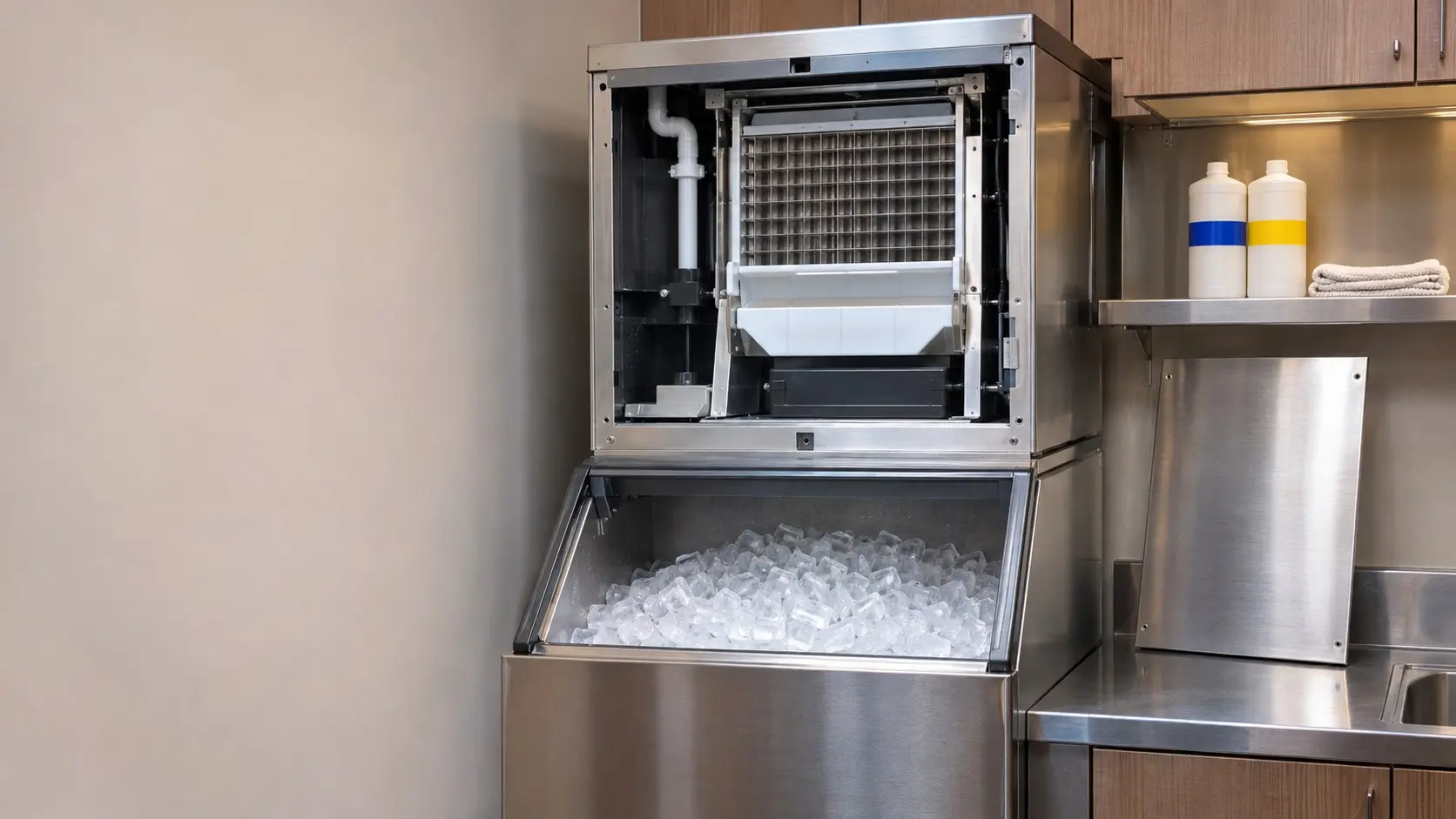
What the visit adds is reach. The built-in cycle moves solution through the water system, but it is not a substitute for cleaning the ice bin, the door, the chute or the scoop holder by hand, and it does not clean a condenser. A technician takes the covers off, wipes or soaks the parts the solution does not touch, and looks at what the cycle cannot show: a sensor coated in scale, a drain that is slow, a filter that is overdue.
What a thorough visit usually includes
- Descale and sanitize cycle with the cleaner and sanitizer the maker names
- Cleaning of the bin, door, chute and scoop holder
- Wiping mineral from the water level and thickness probes
- A look at the drain and the air gap
- Condenser cleaning on air-cooled models
- Water filter check or change
Ask what is on the list before you book, because "cleaning" means a rinse at some companies and a full strip-down at others.
How often does an ice machine need a professional clean?
At least twice a year for a commercial machine, and more often when the water or the room is hard on it. The owner's manual for many commercial models says to descale and sanitize about every six months, and some compact clear-ice models ask for it more often, at the alert or on a shorter calendar; check your manual for the interval.
Three conditions move the date earlier.
Hard water
Scale builds faster, and a filter does not replace a descale. Manuals commonly add that a machine needing more frequent cleaning should have its water quality tested and treated.
Airborne yeast and flour
Manuals note that machines near bakeries need sanitizing more often, and a dirty condenser in a flour-dusty room adds to the load.
Heavy use or a hot room
A machine that runs hard in a hot room has more to clear, so check it earlier than the calendar says.
For a business, the FDA Food Code adds a second rule: ice bins and the enclosed parts of an ice maker are to be cleaned at the manufacturer's frequency or, without one, often enough to prevent soil or mold. Your health inspector will ask when it was last done, so keep the invoice.
Source: FDA — Food Code 2022, 4-602.11(E)(4) — ice bins and enclosed ice maker components cleaned at the manufacturer's frequency

What can you do yourself, and what should you leave?
You can handle the surface work and the cycle itself, but not the products or the parts that need disassembly. The split below matches how most manuals divide the work.
| Job | Owner | Technician |
|---|---|---|
| Run the built-in clean cycle | Yes, with the maker's products | If the cycle fails or scale is heavy |
| Wash the bin and scoop | Yes, as needed | Included in a visit |
| Wipe the exterior | Yes, with mild soap | Included |
| Clean the condenser | Air-cooled, if the fins are reachable | Remote or hard to reach |
| Wipe the probes | Only if the manual shows how | Included |
| Remove heavy scale | No | Yes |
| Check the drain and air gap | Look only | Yes |
If you do run the cycle, the manuals are strict about it. Manuals say to wear rubber gloves and safety goggles, never mix descaler and sanitizer, and use the maker's own products. They also say all ice produced during the procedure must be discarded. A machine's exterior panels may not tolerate chlorinated or abrasive cleaners, so wiping with the wrong product can mark the cabinet.
When is a cleaning visit worth booking before the date?
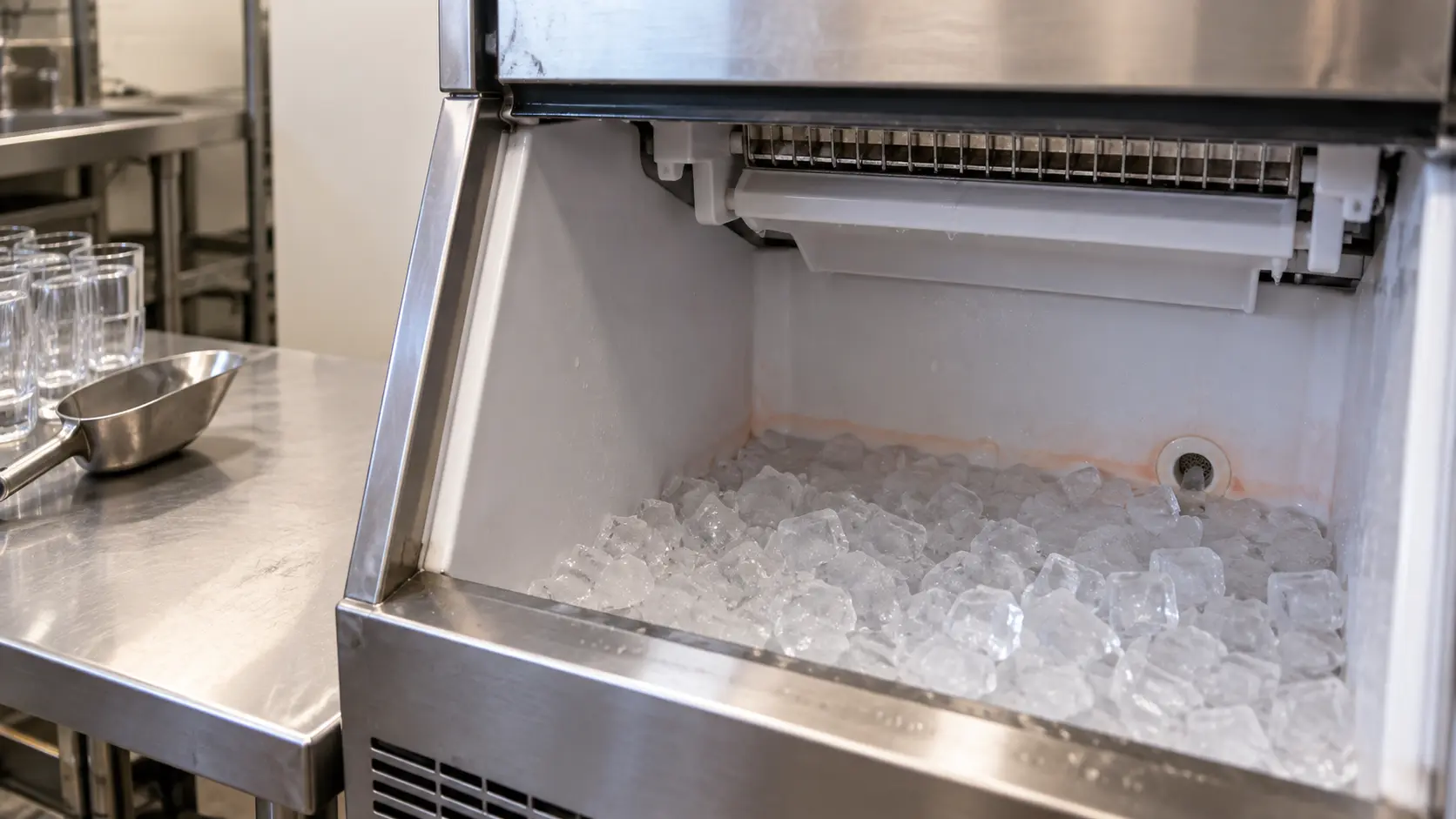
Book early when the machine tells you something has changed, because a cleaning often fixes the change. The most common triggers are slime or a pink film in the bin, ice that tastes or smells off, cubes that come out small or cloudy, a slower harvest, and a cleaning alert that returns soon after you ran the cycle.
Those are the signs of scale or biofilm, not of a failing compressor, and the slime and mold guide shows what the growth looks like. The water filter and scale guide explains why a new filter does not replace a descale. A dirty thickness probe can keep the machine from cycling into harvest, which is one reason a machine can slow down without any part being broken; the making little ice page lists the other causes, and ice that tastes or smells bad has its own checks.
If the ice still tastes off after a clean and a fresh filter, the cause is the water supply or something stored near the bin, and the next step is a diagnostic visit, not another cycle.
How do you compare cleaning services before you book?
You compare them on what is done, what is written down and what is used, not on the label "cleaning." Four questions separate a rinse from a real clean.
- Which products will be used, and are they the ones named in the maker's manual for your model?
- Does the visit include the bin, door, chute, probes and condenser, or only the cycle?
- Will you get a written record with the date and the work done, for the health inspector or your own file?
- What is checked besides cleanliness: the drain, the filter, the ice thickness and the condenser airflow?
For a restaurant or a care home, ask whether the visit can be set to the maker's schedule on a recurring basis, so the date never depends on someone remembering. A home owner with an undercounter machine can ask the same, and read the service page for ice machine cleaning and sanitizing to see what a visit covers on our side. The cleaning and sanitizing guide explains the two chemicals in detail.